Regular readers may remember that we put in a new pond last year. From the beginning it has always been intended as a wildlife pond and now I am pleased to say that the garden population of Rana temporaria are using it as such. There was a pond here about fifteen years ago but when my brother and his wife had children it was removed for safety reasons. Heartbreakingly, for some years after its removal the frogs would lay their spawn on the ground where the pond had been.
But now they are using the new pond for its intended purpose (with the one small issue that they have laid it on top of the safety net, not underneath it, but that is a problem easily solved. And as you can see, Lilith Tinkerbell is very interested in the frogspawn; being a small cat she has never seen such a thing before.
Showing posts with label frogs. Show all posts
Monday, February 17, 2014
Friday, February 24, 2012
JON'S JOURNAL: We shall pick up an existence by its frogs
As regular readers of my rambling will know, I have been following the progress of the poor unfortunate froggies of two areas just outside the village - Kennerland and Huddisford. Lots of them jollily tripped out to procreate at the end of January, and all the resultant spawn was killed in the bitterly cold snap a few weeks ago and is now rotting away.The resultant yucky mess (to use the official scientific terminology) is now rotting away and in some cases appears to acually be fouling the water of the little ponds and ditches where it was deposited by Mr and Mrs Frog the other week.
Now Mr and Mrs Frog seem to have got in the romantic mood again (or at least one couple have - perhaps because it was Valentine's Day last week), because there is one lone batch of frogspawn in the Huddisford ditch. Ironically (if this is the word) it has been laid next to a piece of decaying dead spawn.
It seems to be developing normally, which is good news. However, could the decline in the frog population be due to the fact that so many of them pursue their biological urges too early in the year for the spawn to hatch?
Isn't it a pity that it seems to be illegal now to collect spawn from the wild; because it might be a boost to the population as a whole if someone collected some of the January spawn (which is doomed anyway), raised it in captivity and released the resulting tadpoles when the cold weather is over?
What a pity there aren't any anarchist zoologists about who have a healthy disregard for the law and want to do something good for the environment. Hmmmm
Oh, BTW I was wondering the other day: if I was to post a picture of a pair of Rana temporaria whilst in amplexus would that count as "Frog's porn"?
Thursday, November 17, 2011
FANTASTIC NEWS: Hula painted frog back from the abyss
There is a video at this site but I couldn't embed it properly.For sixty years the Israel painted frog, Palestinian painted frog or hula painted frog (Discoglossus nigriventer) has been held up as a black example of how mankind's meddling with the environment destroys species.
The deliberate draining of the Hula Marsh destroyed several species of fish, and until yesterday it was thought that this frog species was also gone forever.
However, a routine patrol at Ha'H
ula lake found an unknown frog, and scientists have confirmed that it is one of this species!
Saturday, October 01, 2011
Canapés to extinction
Canapés to extinction. The international trade in frogs' legs and its ecological impact. A report by Pro Wildlife, Defenders of Wildlife & Animal Welfare Institute (eds.), Munich (Germany), Washington, D.C. USA). Altherr, S. et al. (2011)
To download the pdf file:
Click here
Thursday, September 30, 2010
MUIRHEAD'S MYSTERIES: OUR FROG DEITY
Somewhere near the top of the Peak there is a rock claimed to personify the frog deity whose evil ambition is to get to the top when the island is devastated. Actually there are only a few who can say definitely where the big rock is, but it is supposed to resemble a giant frog. Some think that the Hog`s Back* (1) bears the resemblance while others point to the mass which can be approached from that part of Conduit Road* (2) near the Victoria Battery filter beds. Another cluster of almost upright boulders which are situated above Marble Hall, are also thought to be the “Frog Rock”.
Irrespective of the position, the story goes that it moved rapidly upwards for some years till it got perilously near the top, when the “Heavenly Virgin”, or “Kwoon Yum” smacked it`s head, with the result that it fell back a good distance. For its audacity in daring to climb up to her preserves – this kindly disposed goddess is presumed to watch over the island`s destinies from a favourable position at the Peak – she cast a charm over the Frog so that his ascending abilities were reduced to not more than the length of a grain of rice a year. So HongKongites can feel relieved. Measured on that basis it will be a matter of centuries before Froggy can get anywhere near the danger zone again.
Efforts have been made to trace the origin of this yarn but those who have faith in it can only say that they were told by somebody else. Others with a reasonable turn of mind can only attribute it to the dislike of the foreigner during the early days of the Colony`s occupation when some patriot devised the story to scare Chinese from settling here permanently. It is said that when the plague was at its worst about thirty years ago there were many who wondered if the Frog Rock had not climbed to just near the top.(3)
*1 Hog`s Back- I`m not sure where this is – presumably a ridge of hill on Hong Kong island,
*2. Conduit Rd – a road on the north-west side of Hong Kong island.
3. The China Mail February 21st 1925 p.8
Richard
THE COMMUNARDS DON`T LEAVE ME THIS WAY
Don`t leave me this way
I can`t survive
I can`t stay alive
Without your love.no,baby
Don`t leave me this way
I can`t exist, I`ll surely miss
Your tender kiss
Don`t leave me this way
Irrespective of the position, the story goes that it moved rapidly upwards for some years till it got perilously near the top, when the “Heavenly Virgin”, or “Kwoon Yum” smacked it`s head, with the result that it fell back a good distance. For its audacity in daring to climb up to her preserves – this kindly disposed goddess is presumed to watch over the island`s destinies from a favourable position at the Peak – she cast a charm over the Frog so that his ascending abilities were reduced to not more than the length of a grain of rice a year. So HongKongites can feel relieved. Measured on that basis it will be a matter of centuries before Froggy can get anywhere near the danger zone again.
Efforts have been made to trace the origin of this yarn but those who have faith in it can only say that they were told by somebody else. Others with a reasonable turn of mind can only attribute it to the dislike of the foreigner during the early days of the Colony`s occupation when some patriot devised the story to scare Chinese from settling here permanently. It is said that when the plague was at its worst about thirty years ago there were many who wondered if the Frog Rock had not climbed to just near the top.(3)
*1 Hog`s Back- I`m not sure where this is – presumably a ridge of hill on Hong Kong island,
*2. Conduit Rd – a road on the north-west side of Hong Kong island.
3. The China Mail February 21st 1925 p.8
Richard
THE COMMUNARDS DON`T LEAVE ME THIS WAY
Don`t leave me this way
I can`t survive
I can`t stay alive
Without your love.no,baby
Don`t leave me this way
I can`t exist, I`ll surely miss
Your tender kiss
Don`t leave me this way
Monday, September 20, 2010
THOSE OF YOU INTERESTED IN SOUTH AMERICAN HERPS WILL BE FASCINATED BY THIS
Dear colleagues,
We have just completed a new page with recordings and pictures of frogs from the new Sound Guide of the frogs and toads of southern Brazil and Uruguay (scientific editors: Axel Kwet and Rafael Marquez). A 2 CD-audio including recordings of 109 species of frogs and toads from Southern Brazil and Uruguay including chorus and soundscapes. With a 56 page book in English, Portuguese and Spanish with pictures and distribution maps of the recorded species.
If you want to check it out, follow the link in the front page of:
http://www.fonozoo.com/
Any report of glitches, comments, and/or suggestions for improvement are welcome.
Warm regards from Axel Kwet and Rafael Marquez
Dr. Rafael Marquez
Fonoteca Zoológica
Museo Nacional de Ciencias Naturales (CSIC)
José Gutierrez Abascal 2
28006 Madrid
Spain
We have just completed a new page with recordings and pictures of frogs from the new Sound Guide of the frogs and toads of southern Brazil and Uruguay (scientific editors: Axel Kwet and Rafael Marquez). A 2 CD-audio including recordings of 109 species of frogs and toads from Southern Brazil and Uruguay including chorus and soundscapes. With a 56 page book in English, Portuguese and Spanish with pictures and distribution maps of the recorded species.
If you want to check it out, follow the link in the front page of:
http://www.fonozoo.com/
Any report of glitches, comments, and/or suggestions for improvement are welcome.
Warm regards from Axel Kwet and Rafael Marquez
Dr. Rafael Marquez
Fonoteca Zoológica
Museo Nacional de Ciencias Naturales (CSIC)
José Gutierrez Abascal 2
28006 Madrid
Spain
Wednesday, May 05, 2010
TONY LUCAS WRITES

Hi Jon,
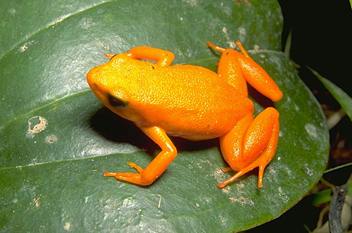
Thought you would be interested in this for the bloggo. There is a new mutation turning up in New Zealand captive bred frogs: Golden frogs; and a Lutenistic colour is also appearing as well. They are fetching a very high price and apparently breed true.
Tony Lucas
Tony Lucas
Monday, March 29, 2010
RUBY LANG: Bell frog bounces back
The yellow-spotted bell frog was once ubiquitous in the northern and southern tablelands of NSW, but was almost wiped out after the chytrid fungus arrived from Africa in the early 1970s.
It was found alive and well in 2008 by government researcher Luke Pearce, who was searching for a native fish, the southern pygmy perch. Instead, he spotted the bell frog, which has distinctive markings on its groin and thighs.
Read more here:
Tuesday, March 16, 2010
Joseph and his technicolour dreamtoad, and other friends.
The following appeared in the Daily Express....
'A TECHNICOLOR frog has been found Down Under - 30 years after it was thought to have become extinct. The yellow-spotted tree frogs - all 100 of them - were found in New South Wales, proof that there is life after death.
'ONE of my favourite animals has been given a lifeline by British taxpayers. The Mountain Chicken - a giant frog which barks like a dog and raises its tadpoles - has won a grant from Britain's Darwin Initiative. I held one in the rainforest on the Caribbean island of Montserrat as a volcano erupted. The frog's skin secretes a chemical that burns any cuts on your skin, an incredible creature.'
Liz's Note: I don't know who the writer of this piece was but he knows how to live, if not how to punctuate his sentences....
'A TECHNICOLOR frog has been found Down Under - 30 years after it was thought to have become extinct. The yellow-spotted tree frogs - all 100 of them - were found in New South Wales, proof that there is life after death.
'ONE of my favourite animals has been given a lifeline by British taxpayers. The Mountain Chicken - a giant frog which barks like a dog and raises its tadpoles - has won a grant from Britain's Darwin Initiative. I held one in the rainforest on the Caribbean island of Montserrat as a volcano erupted. The frog's skin secretes a chemical that burns any cuts on your skin, an incredible creature.'
Liz's Note: I don't know who the writer of this piece was but he knows how to live, if not how to punctuate his sentences....
Wednesday, August 19, 2009
PRESS RELEASES FROM DURRELL WILDLIFE: Mountain Chicken
Abstract:
An emergency rescue operation to save the critically endangered mountain chicken frog from certain extinction has had a major breakthrough with the birth of four batches of tadpoles at Durrell Wildlife Conservation Trust and Parken Zoo.
Body:
An emergency rescue operation to save the critically endangered mountain chicken frog from certain extinction has had a major breakthrough with the birth of four batches of tadpoles at Durrell Wildlife Conservation Trust and Parken Zoo. Conservationists at Durrell are also delighted to have captured high quality film footage of the female frogs caring for their young, giving an invaluable insight into the behaviour of this species. The births at the two institutions follow a rescue mission earlier this year, during which 50 individuals were taken from the Caribbean island of Montserrat following the outbreak of a deadly fungal disease called
Chytridiomycosis. These tadpoles are now the best hope of saving this species on the island.
The mountain chicken frog Leptodactylus fallax is one of the largest frogs in the world, but it has also become one of the most threatened. Thought to have once occurred on seven Caribbean islands, it is now restricted to Montserrat and Dominica. However, the arrival of chytrid fungus all but wiped out the population on Dominica and since February this year has caused major declines in Montserrat pushing this species to the brink of extinction.
Durrell Wildlife Conservation Trust has worked with mountain chickens in Montserrat and in captivity for ten years. As soon as dead frogs were discovered by the Montserrat Department of Environment, Durrell sent a team of herpetological and veterinary experts to the island to survey the extent of the disease and train local forestry staff in bio-security techniques to limit the spread of the disease. A cause for hope came with the discovery of an apparently healthy population that had remained isolated in one of the most important sites for the frog, a location in a mountainous area, called Fairy Walk.
A recovery programme was quickly set up and 50 frogs were brought into captivity to breed and ensure the long term survival of the species. Twelve frogs came to Durrell’s headquarters in Jersey, 12 went to London Zoo and 26 to Parken Zoo in Eskilstuna, Sweden. All frogs are kept in strict bio-secure conditions to minimise any risk of disease transmission either to or from these animals. The challenge for each of the institutions holding the animals was to get them to reproduce, as they are notoriously difficult to breed because of the intense parental care behaviour. Although there are mountain chickens in more than 20 institutions worldwide, only Durrell has managed to breed them regularly in Europe since 1999.
These four batches could result in over 100 frogs available within the first generation born from the rescued population. Dr. Gerardo García, Durrell’s Head of Herpetology, says this is extremely exciting;
“Not only have we been able to start breeding the frogs within the first six months of the rescue
operation but we were also able to watch and film the females feeding unfertilised eggs to their
tadpoles. It is normally such a private and secretive moment that we never thought we would be able to capture it with such clarity. These are incredible images that show us a new facet of their behaviour as we race to save them from extinction.”
The goal of the captive breeding programme is to build up a large number of frogs that can be
introduced back into Montserrat to chytrid free areas of the island within the next two years. The birth of these four batches is an important step towards this goal.
Through the collaborative efforts of Durrell, Parken Zoo and the Zoological Society of London the restoration of this species looks promising by studying the spread of the fungus in the wild, how it may be controlled and then how animals can be placed in safe locations on the island.
Helena Olsson, Zoo Director of Parken Zoo was very excited when the nests were confirmed fertile, “I have been working closely with colleagues in Jersey to create the conditions that would best replicate the situation in the wild and get the animals breeding. We used modeller’s clay to build nest burrows that would suit the frogs and it seems to have worked. Our huge commitment to this programme has bourn fruit and we’re proud to be part of the effort to reverse the fortunes of this species”.
Additional information
Chytridiomycosis
Amphibian chytridiomycosis was first discovered in 1998, when it was found to be the main cause of amphibian declines in the rain forests of Australia and Central America. Since then, this disease has been associated with amphibian declines and extinctions in many countries. Indeed, it has been found to be an emerging threat to > 300 species (of frog, toad, newt and salamander) representing at least 14 amphibian families across 6 continents. In Dominica, which is the other island with mountain chickens, chytrid first emerged in 2002 when large numbers were reported to be dead or dying. The disease quickly spread across the island and the mountain chicken population declined by approximately 80% within two years of the first confirmed cases.
The mountain chicken recovery programme
A Species Action Plan (SAP) is a scientifically authoritative, strategic document that defines specific, measurable objectives and actions for conserving priority species. The SAP for the Mountain Chicken in Montserrat was developed at a participatory workshop, held in October 2007 in Montserrat. The Plan’s Vision is of “a thriving, sustainably managed population of mountain chickens generating pride in Montserrat’s natural and cultural heritage for present and future generations.” Its aim is to bring about “a measurable increase in the security of the mountain chicken population on Montserrat” over the next five years. Due to the outbreak of the chytrid fungus in Montserrat early this year a Recovery Programme is being developed to stop the accelerated process of extinction of the wild populations in the island and their revival through an intensive captive breeding and reintroduction programme.
Caron Glover, Durrell Wildlife Conservation Trust, Press Office
Tel: +44 (0)1534 860026/00
Fax: +44 (0)1534 860001
Email: pressoffice@durrell.org
Website: www.durrell.org
Note to editors:
The Durrell Wildlife Conservation Trust was founded by author and naturalist Gerald Durrell fifty years ago with a mission to save species worldwide, and it has a proven track record of doing just that.
Species that have been pulled back from the brink include the Mauritius kestrel, pink pigeon, echo parakeet and Mallorcan midwife toad, and our dedicated conservationists are hard at work in threatened habitats around the world continuing the battle to protect and conserve many more.
With its international headquarters in Jersey, the Trust has built up a worldwide reputation for its pioneering conservation techniques, developed under the leadership of its founder, the late renowned author and naturalist Gerald Durrell. Today, Durrell Wildlife is continuing to develop its overseas work in new areas of the world, with a particular focus on vulnerable communities of endemic animals, which make such a valuable contribution to global biodiversity.
"When asked, as I frequently am, why I should concern myself so deeply with the conservation of animal life, I reply that I have been very lucky and that throughout my life the world has given me the most enormous pleasure. But the world is as delicate and as complicated as a spider's web. If you touch one thread you send shudders running through all the other threads. We are not just touching the web we are tearing great holes in it." Gerald Durrell 1925-1995.
An emergency rescue operation to save the critically endangered mountain chicken frog from certain extinction has had a major breakthrough with the birth of four batches of tadpoles at Durrell Wildlife Conservation Trust and Parken Zoo.
Body:
An emergency rescue operation to save the critically endangered mountain chicken frog from certain extinction has had a major breakthrough with the birth of four batches of tadpoles at Durrell Wildlife Conservation Trust and Parken Zoo. Conservationists at Durrell are also delighted to have captured high quality film footage of the female frogs caring for their young, giving an invaluable insight into the behaviour of this species. The births at the two institutions follow a rescue mission earlier this year, during which 50 individuals were taken from the Caribbean island of Montserrat following the outbreak of a deadly fungal disease called
Chytridiomycosis. These tadpoles are now the best hope of saving this species on the island.
The mountain chicken frog Leptodactylus fallax is one of the largest frogs in the world, but it has also become one of the most threatened. Thought to have once occurred on seven Caribbean islands, it is now restricted to Montserrat and Dominica. However, the arrival of chytrid fungus all but wiped out the population on Dominica and since February this year has caused major declines in Montserrat pushing this species to the brink of extinction.
Durrell Wildlife Conservation Trust has worked with mountain chickens in Montserrat and in captivity for ten years. As soon as dead frogs were discovered by the Montserrat Department of Environment, Durrell sent a team of herpetological and veterinary experts to the island to survey the extent of the disease and train local forestry staff in bio-security techniques to limit the spread of the disease. A cause for hope came with the discovery of an apparently healthy population that had remained isolated in one of the most important sites for the frog, a location in a mountainous area, called Fairy Walk.
A recovery programme was quickly set up and 50 frogs were brought into captivity to breed and ensure the long term survival of the species. Twelve frogs came to Durrell’s headquarters in Jersey, 12 went to London Zoo and 26 to Parken Zoo in Eskilstuna, Sweden. All frogs are kept in strict bio-secure conditions to minimise any risk of disease transmission either to or from these animals. The challenge for each of the institutions holding the animals was to get them to reproduce, as they are notoriously difficult to breed because of the intense parental care behaviour. Although there are mountain chickens in more than 20 institutions worldwide, only Durrell has managed to breed them regularly in Europe since 1999.
These four batches could result in over 100 frogs available within the first generation born from the rescued population. Dr. Gerardo García, Durrell’s Head of Herpetology, says this is extremely exciting;
“Not only have we been able to start breeding the frogs within the first six months of the rescue
operation but we were also able to watch and film the females feeding unfertilised eggs to their
tadpoles. It is normally such a private and secretive moment that we never thought we would be able to capture it with such clarity. These are incredible images that show us a new facet of their behaviour as we race to save them from extinction.”
The goal of the captive breeding programme is to build up a large number of frogs that can be
introduced back into Montserrat to chytrid free areas of the island within the next two years. The birth of these four batches is an important step towards this goal.
Through the collaborative efforts of Durrell, Parken Zoo and the Zoological Society of London the restoration of this species looks promising by studying the spread of the fungus in the wild, how it may be controlled and then how animals can be placed in safe locations on the island.
Helena Olsson, Zoo Director of Parken Zoo was very excited when the nests were confirmed fertile, “I have been working closely with colleagues in Jersey to create the conditions that would best replicate the situation in the wild and get the animals breeding. We used modeller’s clay to build nest burrows that would suit the frogs and it seems to have worked. Our huge commitment to this programme has bourn fruit and we’re proud to be part of the effort to reverse the fortunes of this species”.
Additional information
Chytridiomycosis
Amphibian chytridiomycosis was first discovered in 1998, when it was found to be the main cause of amphibian declines in the rain forests of Australia and Central America. Since then, this disease has been associated with amphibian declines and extinctions in many countries. Indeed, it has been found to be an emerging threat to > 300 species (of frog, toad, newt and salamander) representing at least 14 amphibian families across 6 continents. In Dominica, which is the other island with mountain chickens, chytrid first emerged in 2002 when large numbers were reported to be dead or dying. The disease quickly spread across the island and the mountain chicken population declined by approximately 80% within two years of the first confirmed cases.
The mountain chicken recovery programme
A Species Action Plan (SAP) is a scientifically authoritative, strategic document that defines specific, measurable objectives and actions for conserving priority species. The SAP for the Mountain Chicken in Montserrat was developed at a participatory workshop, held in October 2007 in Montserrat. The Plan’s Vision is of “a thriving, sustainably managed population of mountain chickens generating pride in Montserrat’s natural and cultural heritage for present and future generations.” Its aim is to bring about “a measurable increase in the security of the mountain chicken population on Montserrat” over the next five years. Due to the outbreak of the chytrid fungus in Montserrat early this year a Recovery Programme is being developed to stop the accelerated process of extinction of the wild populations in the island and their revival through an intensive captive breeding and reintroduction programme.
Caron Glover, Durrell Wildlife Conservation Trust, Press Office
Tel: +44 (0)1534 860026/00
Fax: +44 (0)1534 860001
Email: pressoffice@durrell.org
Website: www.durrell.org
Note to editors:
The Durrell Wildlife Conservation Trust was founded by author and naturalist Gerald Durrell fifty years ago with a mission to save species worldwide, and it has a proven track record of doing just that.
Species that have been pulled back from the brink include the Mauritius kestrel, pink pigeon, echo parakeet and Mallorcan midwife toad, and our dedicated conservationists are hard at work in threatened habitats around the world continuing the battle to protect and conserve many more.
With its international headquarters in Jersey, the Trust has built up a worldwide reputation for its pioneering conservation techniques, developed under the leadership of its founder, the late renowned author and naturalist Gerald Durrell. Today, Durrell Wildlife is continuing to develop its overseas work in new areas of the world, with a particular focus on vulnerable communities of endemic animals, which make such a valuable contribution to global biodiversity.
"When asked, as I frequently am, why I should concern myself so deeply with the conservation of animal life, I reply that I have been very lucky and that throughout my life the world has given me the most enormous pleasure. But the world is as delicate and as complicated as a spider's web. If you touch one thread you send shudders running through all the other threads. We are not just touching the web we are tearing great holes in it." Gerald Durrell 1925-1995.
Monday, August 03, 2009
Population Of Nearly Extinct Mountain Yellow-Legged Frog Discovered
From today's HerpDigest:ScienceDaily (July 28, 2009) - For the first time in nearly 50 years, a population of a nearly extinct frog has been rediscovered in the San Bernardino National Forest's San Jacinto Wilderness. Biologists from the U.S. Geological Survey (USGS) assessing suitability of sites to re-establish frogs and scientists from the San Diego Natural History Museum retracing a 1908 natural history expedition both rediscovered the rare mountain yellow-legged frog in the San Jacinto Wilderness near Idyllwild, Calif.
This re-discovery - along with the San Diego Zoo's first successful breeding of the frog in captivity, and successful efforts by California Department of Fish and Game to restore frog habitat - renews hope of survival for this Southern California amphibian.
Globally, amphibians are on the decline because of habitat loss, effects of climate change and the spread of a deadly pathogen called the chytrid fungus. The mountain yellow-legged frog is one of three frogs or toads on the federal Endangered Species List in Southern California. Prior to this recent discovery, USGS researchers had estimated there were about 122 adult mountain yellow-legged frogs in the wild.
USGS and San Diego Natural History Museum biologists found the endangered frog during separate trips in June. The frogs were spotted at two locations about 2½ miles apart in the Tahquitz and Willow creeks in the San Jacinto Mountains. The number of frogs in the area has not yet been determined.
"If this population is large, it could play an important role in the re-establishment of this species across Southern California," said Adam Backlin, a USGS scientist who led the survey team that spotted the first new Tahquitz Creek frogs on June 10.
Biologists from the San Diego Natural History Museum made their find June 25. The museum scientists were retracing the path of a 1908 expedition by the Museum of Vertebrate Zoology, University of California, Berkeley. During that expedition, which covered all elevations and faces of the San Jacinto Mountain region, the frog was collected at five sites. The San Diego Natural History Museum's team is searching for all species of vertebrates - animals with a backbone - in a study of biological change in the region. The biologists were in the Tahquitz Valley area the week of June 21 when Drew Stokes, a field biologist with the museum, found and photographed a single mountain yellow-legged frog in Willow Creek, a tributary of Tahquitz Creek. The museum's study will continue until biologists have completed three surveys at each of the 19 sites studied by the 1908 expedition.
Mountain yellow-legged frogs are not known to migrate far, possibly indicating a significant population. The size of the site represents much more habitat than occupied by the eight other mountain yellow-legged frog populations in the San Jacinto, San Bernardino, and San Gabriel mountain ranges. In those areas, the frog occupies less than a half-mile of stream.
This rediscovery is a windfall for all the partners working to increase the number of mountain yellow-legged frogs in the wild by government and non-profit partners. In addition to the USGS and the San Diego Natural History Museum, the effort involves collaboration between the San Diego Zoo's Institute for Conservation Research, California Department of Transportation (Caltrans), U.S. Fish and Wildlife Service, U.S. Forest Service, University of California and California Department of Fish and Game.
The San Diego Zoo's Institute for Conservation Research was the first to breed a mountain yellow-legged frog in captivity. That amphibian has recently morphed from a tadpole into a froglet, or juvenile frog.
"Historically, scientists have had great difficulty breeding frogs in captivity," said Jeff Lemm, an animal research coordinator for the San Diego Zoo. "We are excited by this success and cautiously optimistic we will have more eggs soon."
In December 2008, researchers at the Institute for Conservation Research discovered a clutch of about 200 eggs in one of its tanks. Researchers were surprised because the frogs were younger than is typical for breeding. Because of the frogs' young age, only a handful of the eggs were fertile. The one frog to mature is thriving. The next breeding season is expected to be December 2009 to March 2010.
The goal of the breeding programme is to return the mountain yellow-legged frog to its native habitat.
The zoo's breeding programme, in conjunction with its partners, began after the rare frogs were rescued from a drying creek. Anne Poopatanapong, a wildlife biologist for the San Jacinto Ranger District in the San Bernardino National Forest was monitoring declining creek water levels in Dark Canyon on Aug. 23, 2006, when she noticed many pools drying up, including one where frogs had been living. Concerned about losing the tadpoles, she called the Fish and Wildlife Service and the salvage effort started the next day. A USGS team led by Dr. Robert Fisher rescued 82 tadpoles, which were taken to the San Diego Zoo's Institute for Conservation Research.
The frog recovery effort has been funded by Caltrans in part to mitigate for emergency work to stabilise a slope near the frog's habitat on state Route 330 in the San Bernadino Mountains.
"The emergency slope reconstruction project had the dual benefit of opening a road that was about to fail as well as helping to ensure that the last known population of the mountain yellow-legged frog in the San Bernardino Mountains had a program in place to aid the frog's recovery," said Craig Wentworth, a senior environmental planner/biologist with Caltrans.
Jim Bartel, the field supervisor for the Fish and Wildlife Service office in Carlsbad, said his agency is pleased to participate in the effort to rescue the mountain yellow-legged frog and conserve its remaining riparian habitat.
"We look forward to reintroducing the species to its native habitat," Bartel said.
Habitat protection and restoration, combined with efforts to reintroduce these frogs to areas where they have been decimated, offers the best hope of returning mountain yellow-legged frogs in Southern California to a healthy, self-sustaining population.
The California Department of Fish and Game is dedicated to the completion of the Little Rock Creek trout removal project to benefit the endangered mountain yellow-legged frog. Working with USGS and U.S. Fish and Wildlife Service, trout populations have been significantly reduced in Little Rock Creek in the Angeles National Forest. As a result, frog presence in the section of the creek where the fish were removed has increased, demonstrating the success of this collaborative effort.
Adapted from materials provided by US Geological Survey.
Monday, May 11, 2009
ALAN FRISWELL: Scary Spider Stories #3 - The Fearsome frog-eating spider of Epping Forest
I vaguely remembered Richard F having said that one of his mates had offered to make us a feegee mermaid, but I had forgotten all about it. Sad to say, so many people offer to do stuff for us, and then fail to deliver, that I had got into the habit of treating all such offers cum grano salis, but the advent of Alan shows that I should not be such a cynical old sod. Now he has become a guest blogger, and furthermore a guest blogger who's output is often so elegantly macabre that I have started hassling him to write us a book..
Although the British Isles has long been a haven to crypto-legends of lake monsters, black dogs, mystery cats, seemingly out-of-place creatures such as Owlman and even putatively spectral forms of Bigfoot; giant spiders, for some reason, just don’t seem to belong.
Perhaps because of their more fictional, story-book association with forbidding, overgrown jungles and forgotten places where the unwary explorer might encroach upon forbidden territory at the risk of ending up in the cooking pot or with their head on a pole, giant arachnids certainly fit more comfortably into this more exotic milieu in the public consciousness, than the more mundane backdrop of familiar surroundings. Or in other words, a giant, man-eating spider in Peru would inspire little, or no scepticism--at least, inasmuch as having a viable ecosystem in which to potentially flourish--while one in Albert Square, however desirable, would unfortunately be rather more untenable.
But sometimes, stories of monstrous spiders do occur somewhat closer to home, and I now introduce the first of two such tales.
This first, which I present as a completely true story, is the lesser of the two in terms of the ‘fear factor’; so if this one gives you the creeps, believe me, you have no idea of what’s coming next….
Paul Hallewell, a friend of mine for many years--we were at art college together--were in a pub one evening having few pints--not an uncommon occurrence by any means. At the time we were both working on a cartoon animation film produced by--believe it or not--Steven Spielberg (one afternoon at work, I had the chance to meet Spielberg, but I preferred to stay in the pub and get pissed. Is that class, or what?). The film was called An American Tail II, and featured, among other characters, a giant Mexican spider.
We were discussing this spider, and the way that we were going to animate it in the film, when Paul told me that he had once seen a gigantic spider in the woods, to which I replied; “Well bo****ks to American Tail II, tell me about this instead!”
And so he did.
And so he did.
When Paul was about ten, he belonged to a local boy scout troop. Part of the orienteering exercises planned out by the scout leaders involved camping out in the woods, or some other open area; and on this occasion, the troop found themselves travelling by coach to Epping forest, a huge woodland area to the north east of London that had not only been frequented by the legendary highwayman Dick Turpin, but was also the supposed haunt of satanic groups--in whose number was allegedly Edward Heath--and the location of choice for the burial of London gangland victims.
Arriving at midday, the troop immediately set up camp, placing their tents to the side of a small stream; the rest of the day being spent settling in to their new surroundings and preparing the evening meal of sausages and beans.
One thing that soon became apparent, was the loud croaking of frogs from the direction of the stream, and from the many small pools and ponds that dotted the grassy marsh leading up to the thicker part of the forest. The first night the boys spent under the stars was humid, heavy with the droning buzz of mosquitoes and tiny midges; and the frogs’ resonant chorus made sleep difficult for the scouts, already oppressed by the almost tropical August heat.
The next day, the scouts were allowed to explore the woods, as long as safety procedures were observed, and so Paul and some of the others made off for the trees.
They found their way through a large group of wind-blown willow trees, behind which they could see an old deserted house. They discovered the remains of a path that had once led between the trees, now overgrown with wild flowers and brambles. The house, according to Paul, looked like: “something out of Scooby Doo, all broken down and derelict.”
Thinking that the chance to explore a ‘haunted house’ couldn’t be missed, Paul and his mates found their way in through the broken front door, which yielded to their kicks with a crunch of decaying, paint-peeling timber.
The hall, or what was left of it, hung heavy with the smell of stagnant water; the walls, once covered with fine paper, now exposed and damp, the plaster running with moisture.
A staircase led to the first floor, the banisters thick with mould and fungus. As the boys tried the steps, the rotting wood snapped and crumbled, releasing an army of shiny beetles and woodlice, which ran around their shoes.
Paul chucked a stone through one of the already broken windows, and even the sound of breaking glass was muted in the stale, dead air.
One of them suggested a game of hide-and-seek, which was met with general approval; and Paul, being duly elected, ran off to hide.
At the back of the house, a long passageway led to a conservatory of sorts, and Paul decided to find a hiding-place within it’s bushes and shrubs, now choking the window-frames with vines and roots.
Half-way along the passage, Paul found a doorway, leading down to a cellar. Thinking that this would be a great improvement on the conservatory, he pulled on the handle, the hinges screaming under the burden of years of rusted neglect. As the door swung wide, the sharp smell of bitter apples and mould hit him, and Paul realised that the cellar was probably full of rotted fruit.
He could hear water dripping down in the darkness, and the sour scent of mildew and pond weed was thick in the air. I’m going to hand over to Paul at this point, and, although--like Alfie in a previous story--I’m having to paraphrase, it’s pretty much what Paul said.
“It’s weird, but the first thing that happened, was that a huge cloud of butterflies flew past the window at the end of the passageway. It was like a mass of yellow going by. Just then, I heard the sound of frogs croaking, and I knew that they were down in the cellar; there must have been some way that they could get in. Suddenly, dozens and dozens of frogs came hopping out of the cellar. It was a bit scary, really. They were even stuck to the inside of the door, stuck by moisture, I suppose, all hopping out into the passageway. My face was right next to the door, and I pulled back as the frogs were jumping in all directions.
I first saw something out of the corner of my eye. It was very dark, and it moved quickly. I didn’t really have the chance to figure out what it was, before it came out into the light.
My f*****g head was right next to it; I’ve never been scared of spiders, but I nearly died. This thing was actually chasing the f*****g frogs, I mean really chasing them. It was a garden or house spider--the ones with the small bodies and long legs--you know, the things you find on your bedroom ceiling, but this c**t was bigger than a f*****g tarantula--bigger than any spider I’ve ever seen in my life. I jumped back and hit my head on the opposite wall, and saw the spider fully. The legs were amazingly thick--not thin or spindly--and the whole thing looked really strong. Each leg must have been at least eight inches long--I’m not kidding. It had bristles like fuse wire--stiff and black. It was a dark brown colour, the body had a dark pattern along the back. I could actually see it’s f*****g fangs--they were about an inch long at least, then the worst thing of all, it grabbed one of the frogs. It just grabbed it like an ordinary spider would a fly, and blood came pouring from it’s body as the fangs want in. F**k that for a game of soldiers.
At that point, my bottle went, and I just ran as fast as I could, to get the f**k out. All I can imagine, is that the spider had lived in peace for years, happily eating frogs, and had grown to that giant size. It’s just as well that it wasn’t living on f*****g rats.”
So is it possible that some species of spider, given peace and quiet, and a ready food supply could achieve giant size?
I certainly don’t know, but doesn’t it give you just a little thrill of apprehension, to think of what might just be waiting for you under the garden shed, or in the attic that you haven’t bothered to tidy in years….
Labels:
alan friswell,
epping forest,
frogs,
giant spider,
spiders
Sunday, April 12, 2009
RICHARD FREEMAN: A FROG SO SMALL
European and Peruvian herpetologists have discovered the smallest frog in the world, in the highlands of Manu National Park near Cusco in south-eastern Peru.It was found at an altitude 3000 m (9840 feet) and has been named Noblella pygmaea, or Noble's Pygmy Frog. Females measure less than half an inch (12.5 mm) in snout-vent length, whereas males are just a bit longer than 1 cm.
Noble's pygmy frog lay two eggs, which hatch into fully formed tiny frogs, not tadpoles.
The eggs are laid in moist places such as under mosses or the leaf litter. The mother remains near the eggs to protect them from predators and drying out. The eggs, measure 4 mm in diameter, about two-thirds of the size of their mother.
The frogs inhabit the cloud forest, the montane scrub and the high-elevation grasslands of Manu National Park and of the privately-owned Wayqecha Research Station in the upper Kcosñipata valley, named after a river which is a tributary to the Madre de Dios River in the Amazon basin. Their altitude range seems to be restricted between 3000 and 3200 metres (9840-10500 feet).
The Noble's Pygmy Frog is one among over 10 new frog species discovered over the past 2 years in the cloud forests of Cusco.
Saturday, February 28, 2009
HARDCORE BATRACHIAN EROTICA
As any visitor to the Weird Weekend over the past few years will know, one of my late father's friends often makes an appearance. He is the Rev. Gerald Smith who was once the Vicar of the South Pole. Honest!OK he was actually the RAF Chaplain to the garrison on the Falkland Islands, and as part of his flock he ministered to the British Antarctic Territory - a peripetetic community of about 200 scientists and military bods - who have been there on and off since Britain claimed sovreignty over part of the southernmost continent in 1908.
However, he is a very interesting chap with a feast of interesting stories to tell, and he and his wife Ann always come to the Weird Weekend Cocktail Party where they drink my champagne like it was going out of fashion and generally have
a jolly good time
However, he is also a keen nature photographer, and sends me lots of images that he thinks may be of interest. Like these..
He knows of my interest in the stories of bright yellow, and even golden frogs in the Devon countryside, and he sent me these pictures that he took on friday of two common frogs in amplexus in his garden, with a note commenting on the marked colour difference between them
This has actually made me decide to bring a long standing project of mine back to the fore. The colour variations on British frogs are so great that we think that it is about time that they were documented, so this spring, can you all please get your digital cameras out and photgraph as many different froggies of differing sizes, markings and colouration as you can. Email tjhem to me with locality notes and we shall post them on a dedicated section of the CFZ website...
Labels:
brown frog,
center for fortean zoology,
centre for fortean zoology,
cfz,
common frog,
frogs,
variation
Thursday, February 05, 2009
FROM THE ARCHIVES: The golden frogs of Bovey Tracey
Once upon a time, at least according to an old Devon folk story, a poor woodsman lived with his family on the outskirts of the village of Bovey Tracey. Their child was suffering from an unspecified illness and was not likely to live much longer, One night in the middle of a severe thunderstorm there was a knock on the door and a mysterious lady entered demanding shelter and food.
Despite their many misfortunes the woodsman and his family welcomed the mysterious lady, gave her milk and food (which they could ill afford) and a seat by the fire. She then blessed the ailing infant who was miraculously cured, and before vanishing (up a road called to this day Mary Street) she said that so that her benefactors would know this was not a dream, not only would the child be forever cured but that the next day the family would discover a new spring full of crystal clear water and bright golden frogs which were said to have populated the area for many years.
Another piece of interesting supportive evidence for this story is that, to this day in what is still known as Mary Street there is a Holy Well! It can be found embedded in the stone wall opposite Bovey Tracey hospital. Could this be the site of the spring created by the old woodsman`s mysterious visitor?
Unfortunately, although there is some evidence to suggest that this was not its original location and that it was repositioned there a century or so ago,m a quick trip to the Westcountry Studies Library will reap some useful rewards.
According to even the most early maps of the area there are a number opf wells and springs in the close vicinity of where the holy well now stands. Some of them are marked with a cross, which would imply that they were of some special spiritual significance.
So, assuming the golden frogs exist(ed) what were/are they? The concept of brightly coloured amphibians inhabiting the English countryside is not as unusual as one might suppose. Several small pink frogswere found in Gloucestershire in the early 1990s and others have been recorded over the years from Sussex and The Cotswolds.
But Golden Frogs?
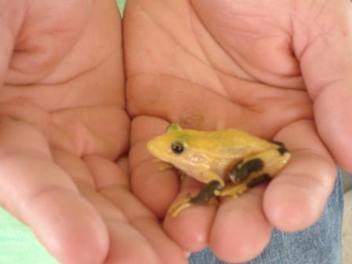
In February 1994 local and national newspapers were full of the story of Jaffa, a three year old frog discovered in a garden in Truro. Jaffa was, as his name implies, bright orange. The Westcountry TV News carried a story about him which said that he, and a similarly coloured mate had been released in a secret location. Mark Nicholson of the Cornwall Trust for Nature Conservation revealed that far from being an isolated occurrence these oddly coloured amphibians are popping up all over the place. Ranging in colour from bright orange, through yellow to pale cream, these creatures have been reported from all over the westcountry and even from elsewhere in the UK although they appear to be much rarer.
They turn up each year, and in the early spring of 2000 we found one hopping around in the mud by the dustbins outside our front door! It was a fully grown female of a bright mustard colour and almost immediately laid copious amounts of spawn which, unfortunately proved to be infertile. We kept her for several months until she escaped into the wilderness behind our conservatory where we keep some of our animal collection during the summer months. We hope that the coming years will supply us with more specimens that will help us determine what exactly these creatures are.
Although I am as aware as everyone about the damage that man is doing to the planet on which we live, there is a distressing tendency in these politically correct days to blame all anomalies of nature on the ubiquitous `global warming` or some other plague of the modern age. Whilst not wishing for a moment to deny that these threats exist and a very serious towards the future of all living creatures on the planet, it is, I think, counter productive to blame everything on man`s stupidity. Various commentators including Internet news groups have suggested that these brightly coloured batrachians are the result of a damaged environment. Whilst not denying that the environment is certainly damaged, we have proved that these animals have been around for at least five hundred years and we are determined to find out what they actually are!
For the present however, it is fairly clear that the charming medieval legend of the Golden Frogs of Bovey Tracey might not he so far fetched after all.
Despite their many misfortunes the woodsman and his family welcomed the mysterious lady, gave her milk and food (which they could ill afford) and a seat by the fire. She then blessed the ailing infant who was miraculously cured, and before vanishing (up a road called to this day Mary Street) she said that so that her benefactors would know this was not a dream, not only would the child be forever cured but that the next day the family would discover a new spring full of crystal clear water and bright golden frogs which were said to have populated the area for many years.
Another piece of interesting supportive evidence for this story is that, to this day in what is still known as Mary Street there is a Holy Well! It can be found embedded in the stone wall opposite Bovey Tracey hospital. Could this be the site of the spring created by the old woodsman`s mysterious visitor?
Unfortunately, although there is some evidence to suggest that this was not its original location and that it was repositioned there a century or so ago,m a quick trip to the Westcountry Studies Library will reap some useful rewards.
According to even the most early maps of the area there are a number opf wells and springs in the close vicinity of where the holy well now stands. Some of them are marked with a cross, which would imply that they were of some special spiritual significance.
So, assuming the golden frogs exist(ed) what were/are they? The concept of brightly coloured amphibians inhabiting the English countryside is not as unusual as one might suppose. Several small pink frogswere found in Gloucestershire in the early 1990s and others have been recorded over the years from Sussex and The Cotswolds.
But Golden Frogs?
In February 1994 local and national newspapers were full of the story of Jaffa, a three year old frog discovered in a garden in Truro. Jaffa was, as his name implies, bright orange. The Westcountry TV News carried a story about him which said that he, and a similarly coloured mate had been released in a secret location. Mark Nicholson of the Cornwall Trust for Nature Conservation revealed that far from being an isolated occurrence these oddly coloured amphibians are popping up all over the place. Ranging in colour from bright orange, through yellow to pale cream, these creatures have been reported from all over the westcountry and even from elsewhere in the UK although they appear to be much rarer.
They turn up each year, and in the early spring of 2000 we found one hopping around in the mud by the dustbins outside our front door! It was a fully grown female of a bright mustard colour and almost immediately laid copious amounts of spawn which, unfortunately proved to be infertile. We kept her for several months until she escaped into the wilderness behind our conservatory where we keep some of our animal collection during the summer months. We hope that the coming years will supply us with more specimens that will help us determine what exactly these creatures are.
Although I am as aware as everyone about the damage that man is doing to the planet on which we live, there is a distressing tendency in these politically correct days to blame all anomalies of nature on the ubiquitous `global warming` or some other plague of the modern age. Whilst not wishing for a moment to deny that these threats exist and a very serious towards the future of all living creatures on the planet, it is, I think, counter productive to blame everything on man`s stupidity. Various commentators including Internet news groups have suggested that these brightly coloured batrachians are the result of a damaged environment. Whilst not denying that the environment is certainly damaged, we have proved that these animals have been around for at least five hundred years and we are determined to find out what they actually are!
For the present however, it is fairly clear that the charming medieval legend of the Golden Frogs of Bovey Tracey might not he so far fetched after all.
Labels:
amphibia,
center for fortean zoology,
centre for fortean zoology,
cfz,
cryptid,
cryptozoology,
frogs,
golden frogs
Saturday, January 31, 2009
GUEST BLOGGER FLEUR FULCHER: Battletoads - beleaguered batrachians and ambushed anurans
Over, once again to the divine Ms F. Charming as usual, she is taking up cudgels on behalf of the poor downtrodden amphibians of the planet. They are in crisis - but there is good news as well...Worldwide things are looking dire on the amphibian front, the Chytrid disease has been spreading fast and there is as yet no treatment, one billion frogs also end up as food for humans each year, or used in traditional medicines and rituals.
Yet there are still pieces of good news from the amphibian world, an expedition by Frontiers has discovered 15 new species in Tanzania’s remote mountain forests. Some of these are bizarre looking, brightly coloured and covered in lumps, bumps and growths. But the most unusual characteristic displayed by the newly found Nectophrynoides toads is that they give birth to live offspring rather than laying eggs.
As well as these toads there is a new type of very cute looking burrowing toad belonging to the genus Probreviceps, unfortunately, this little toad is already in danger from habitat loss, the ecologically important forests in which it lives are rapidly being felled.
The success of this expedition shows the need for more exploration into the more remote forests, valleys and mountains to record and protect the animal inhabitants of these places before their homes vanish forever.
If these adorable lumpy bumpy and burrowing toads are not enough to catch your attention to the plight facing our planet’s amphibians then perhaps the ever photogenic tree frog will do the trick, the new one found in Tanzania is from the genus Leptopelis, and I cannot imagine looking into its huge browny gold eyes and telling it I don’t care about frogs and their kin.
It is unfortunate that there are many types of amphibian that are heading towards the same fate as the famous golden toad, but this does not have to happen, if a cure can be found for the disease, important habitats protected and responsible collecting methods for the food and pet trades enforced then who knows how many new species we will find in the future. If those things are not done then it is almost inevitable that many species of amphibian will disappear before science, (and the rest of us) has even had a chance to see them.
Labels:
amphibia,
anurans,
batrachians,
bears new species,
centre for fortean zoology,
cfz,
CONSERVATION,
cryptozoology,
frogs,
new spoecies,
toads,
unknown animals
Subscribe to:
Posts (Atom)