WELCOME TO THE CFZ BLOG NETWORK: COME AND JOIN THE FUN

Half a century ago, Belgian Zoologist Bernard Heuvelmans first codified cryptozoology in his book On the Track of Unknown Animals.

The Centre for Fortean Zoology (CFZ) are still on the track, and have been since 1992. But as if chasing unknown animals wasn't enough, we are involved in education, conservation, and good old-fashioned natural history! We already have three journals, the largest cryptozoological publishing house in the world, CFZtv, and the largest cryptozoological conference in the English-speaking world, but in January 2009 someone suggested that we started a daily online magazine! The CFZ bloggo is a collaborative effort by a coalition of members, friends, and supporters of the CFZ, and covers all the subjects with which we deal, with a smattering of music, high strangeness and surreal humour to make up the mix.

It is edited by CFZ Director Jon Downes, and subbed by the lovely Lizzy Bitakara'mire (formerly Clancy), scourge of improper syntax. The daily newsblog is edited by Corinna Downes, head administratrix of the CFZ, and the indexing is done by Lee Canty and Kathy Imbriani. There is regular news from the CFZ Mystery Cat study group, and regular fortean bird news from 'The Watcher of the Skies'. Regular bloggers include Dr Karl Shuker, Dale Drinnon, Richard Muirhead and Richard Freeman.The CFZ bloggo is updated daily, and there's nothing quite like it anywhere else. Come and join us...

Search This Blog

WATCH OUR WEEKLY WEBtv SHOW

SUPPORT OTT ON PATREON

SUPPORT OTT ON PATREON
Click on this logo to find out more about helping CFZtv and getting some smashing rewards...

SIGN UP FOR OUR MONTHLY NEWSLETTER


Unlike some of our competitors we are not going to try and blackmail you into donating by saying that we won't continue if you don't. That would just be vulgar, but our lives, and those of the animals which we look after, would be a damn sight easier if we receive more donations to our fighting fund. Donate via Paypal today...


Tuesday, September 26, 2006

Where do we go from Here? Is it down to the lake I fear? fa-fa-fa-fa......

Curiouser and curiouser......

When I wrote the last blog entry a week or so ago, the Lake Windermere investigation was still in its infancy, but if - as Harold Wilson is supposed to have said - a week is a long time in politics, then it can be a bloody long time in cryptozoology! It's one of the weirdest things about this business that something is always afoot!

I have always wanted to use the stupid analogy of London buses with cryptozoology; that you wait for ages for one to turn up, and then shed-loads of unknown animals crawl out of the woodwork at times. But that just ain't so! Since the internet made truly global and almost instantaeneous communication a reality, rather than part of one of Arthur C Clarke's pipe dreams, we receive more information on the subject of unknown animals than we know what to do with. Practically every day something gets reported to us, and it is sometimes a very real temptation to get blase about it all. However the vast majority of these reports are from far-flung parts of the world, and in most of these cases we can do little but post the news on our forum, and file it away in our every expanding archive.

Of course, we do have a fighting fund, so that if we are overtaken by events we can fly off at a moment's notice to investigate somethig, but on the whole our foreign trips take some months to organise, and I will admit that it is one of my enduring paranoias that one of these days something will happen that will force us to organise a foreign trip on a moment's notice.

There have been several occasions in the past few years when we have had to mobilise as a `rapid response team` in order to investigate a UK based mystery. The most notable were Martin Mere (2002), Bolam Lake (2003) and the Cannock Crocodile (2003), but I have a sneaking suspicion that the events that are rapidly unfolding on Lake Windermere are going to knock all of the above into a cocked hat.

Our appeal in the Westmoreland Gazette was an overwhelming success.We have now received six witness statements which appear to be of large eels in the lake - what's more; they stretch back over the last half century, so although there is no canonical history of lake monster sightings per se in the Lake District, it does seem that there is a very real mystery to investigate. The most interesting thing about these reports is that not only do they cover a long time frame, but some of them are unquestionably reports of eels, but eels considerably larger than any that are accepted by ichthyologists at the present day. If we can catch or photograph one of these - even if it isn't the monstrous 10-15 footer that was reported by three separate witnesses in July, we are - in my humble opinion - well on our way to proving our big eel hypothesis as an explanation for the animals reported in monster-haunted lakes all across the northern hemisphere.

I waxed lyrical on this subject nearly a year ago after Richard's and my short trip to Loch Ness last November. I quote:

"The European eel (Anguillia anguilla) lives in freshwater until it reaches sexual maturity when the reproductive imperative kicks in and the elongate fish swim down to the sea where (according to most sources) they cannot feed, and swim down to the Sargasso Sea in the South Atlantic where they mate, spawn and die. The larval eels (known as leptocephelae)are the shape of leaves and about the size of a little fingernail. They sweim up the Atlantic to coastal waters where they metamorphose into tiny eels called elvers. These swim up the rivers and the cycle begins again. Howeverr, it has been suggested that occasionally an elver becomes sterile, and so when its peers have attained a length of 4-6 feet and sexual maturity, the biological imperative does not kick in and the eunuch eel (as theyhave been dubbed) stay in freshwater and continue to grow.

This is partly hypothesis, but it makes a fair amount of sense and would certainly explain some of the lake monster sightings which have taken place across the northern hemisphere. For years one of the main stumbling blocks for a viable population of giant animals living in any of the monster-haunted lakes (with the possible exception of Lake Okanagan in Canada, and some of the lesser known lakes in Siberia and Tibet), is the sheer lack of biomass in the waters. There just simply isn't enough food to support them. Another problem is thatthe prehistoric giant reptiles were all e=air breathers, and would have to surface to breathe, and presumably come onto land to breed. There are just simply not enough sightings of these creatures to support such a hypothesis.If, however, our hypothesis is true then we can scratch both of these objections immediately: They obtain their oxygen from the water, and they are occasional visitors or mutations rather than an unknown species of animal."

So there you have it. A small expeditionary force from the CFZ, which will include Me and Richard, and two or three others will be going up to Windermere in the second week of October, and once again the game is afoot.

I am just wondering whether I should insist that everyone reads at least one Arthur Ransome book before we go...

Saturday, September 16, 2006

WEIRD WINDERMERE

As anyone who has read my inky fingered scibblings both here and elsewhere will know, I have long been a fan of the children's author Arthur Ransome . He is best known for his Swallows and Amazons series of children's books, but he was also a folklorist, commentator on the Russian Revolution, and ligitant of Oscar Wilde's one-time lover, Lord Alfred Douglas.

But, like most people I first discovered (and fell in love with) the prose of Swallows and Amazons and its successors. I first read the books in Hong Kong during the second half of the 1960s, and - together with my young compadres - used to relive the adventures of the young protagonists in the books, without paying much attention to the fact that they had been set half a globe away, and some forty years in the past!

It was only when I read a remarkable analysis of the stories by author Christine Hardyment, entitled Nancy Blackett and Captain Flint's trunk, that I discovered - not altogether to my surprise - that Ransome had been somewhat of an armchair cryptozoologist. Amongst fragments written down as the suggestions for a future S&A adventure, included one when they were to travel to Kenya, and have an adventure involving the notorious Nandi Bear.

But what is Downes getting at? I hear you mutter in my mind's ear. This is all very interesting, but is there any point to it?

Well, yes. Ummm sort of.

On the thursday of the Weird Weekend I received a telephone call from a jolly nice chap at the Westmoreland Gazette who tld me that his august publication had just printed the following story:

"A HOLIDAYMAKER has spoken of his horror at seeing a Loch Ness-type monster' emerge from the depths of Windermere, report Paul Duncan and Peter Otway. University lecturer Steve Burnip and his wife, Eileen, were shocked at seeing the serpent-like creature surface from the waters as they stood at a well-known viewpoint. "I was absolutely flabbergasted, I just stood there and couldn't believe what I was looking at," said Mr Burnip, who has been holidaying in the area for 13 years with his family. He claimed the creature was about 15-20ft long with a little head and two small humps following in its wake. "It was like a giant eel." Mr Burnip, who is 51 and from Hebden Bridge, was looking out from Watbarrow point that looks across the lake to Waterhead. Ian Winfield, a fish ecologist for the Centre for Ecology and Hydrology at Lancaster University, believes Mr Burnip could have seen a catfish, as they have been introduced to a lot of lakes for angling. "The Wels catfish comes from mainland Europe and can grow to about 500cm and weigh up to 306kg and there have been numerous records of catfish washing up dead in Cumbrian lakes," said Mr Whitfield. "

Hmmmmmmm, I thought.

The newspaper contacted us because a simple google search for o-o-p wels catfish in the UK comes up with the CFZ. Mostly because of our adventures four years back at Martin Mere but also because of an article I wrote after an old age pensioner's jack russell had been eaten by an errant wels in a boating lake in Germany. I entitled the story "Ding Dong Bells, Doggy's in the Wels", which amused me and infuriated my editor.

However, since then - for better or for worse - me and the boys have been considered experts in out-of-place wels catfish ever since. The fact that this animal (if indeed it is an animal) beas aboiut as much resemblance to a wels catfish as I do to an olympic athlete, has not very much to do with it!

Anyway. Over the past few weeks we have interviewed the witness, and Richard F (who did the main interview) is particularly impressed with the veracity of his story. Most recently, we have placed an appeal in the newspaper which first ran the story, asking for more witnesses and further information. We have had a couple of interesting `phone calls so far, and will keep you in the loop as to what is happening. There may well be a CFZ trip oop t'north in the offing, and when it happens you guys will be the first to know.

But what the £$%^%^&&&* has all this to do with Arthur Ransome? You might well ask!

The main canon of the Swallows & Amazons stories are set on an un-named lake in the Lake District, that according to Christine Hardyment (and others) is a composite place comprised of various bits of Coniston Water and Lake Windermere itself. As Wikipedia succinctly put it:

"Generally, the geography of the lake resembles Windermere (though Wild Cat Island has a number of important elements from Peel Island on Coniston Water) while the fells and hills surrounding it more resemble the area around Coniston"..

But there is more revelance to the current quest than this. More relevance even that one of the original dinghys from the story can still be found in the local museum at Lake Windermere.

When I was a boy I used to spice up my Ransomesque adventures with my pals into Swallows & Amazonish hunts for mystery animals. Eventually me, my mate William Topley (where the hell are you dude? I have had no contact wityh you since 1970), and a handful of others became a close knit gang whose main raison d'etre was avoiding doing what society told us to (in those days - going to school), and hunting for mystery animals.

Four decades later I am doing exactly the same thing. Maybe the children's book featured in today's blog should have been Peter Pan!

Tuesday, September 12, 2006

I'm back... and this time it's personal

Hi folks,

It has been about three weeks since I last wrote on this blog, and newbies might have wondered what has happenned.

Firstly - a nice reason:

It was my 47th Birthday a few days after the Weird Weekend, and Corinna and I went away on holiday for a few days. We went to Jersey, mainly to visit Jersey Zoo, which was founded just before I was born by my hero Gerald Durrell.

I first went there forty years ago in the summer of 1966, and I have to admit that I was rather disappointed. Even at the age of seven I had read many of Durrell's books and I was expecting to see a marvellous zoo. Even at the age of seven, I was disappointed. It was obviously home-made and down at heel. The cages were made out of orange crates and chicken wire, and the whole place had a dilapidated air about it.

It was only when I read Douglas Botting's masterful biography of Durrell, that I realised that I had first visited the place at a pivotal moment in its history! He had left the zoo in the care of his old friend Ken Smith, ex-Whipsnade, and later the founder of Exmouth Zoo. Smith is a somewhat maligned figure in the hagiography of Durrell, because under his tutelage the zoo became very shambolic indeed, and was in imminent danger of closing. It should be said at this juncture, that having run the CFZ for nearly fifteen years, I am only too aware of what a difficult job juggling financial matters is, and I sincerely doubt whether Ken Smith should really be blamed for what happened. Gerry, however, did blame him, and he was summarily sacked.

My first visit forty years ago coincided with the initial time when Gerry and his team were desparately clawing themselves back from the brink of bankruptcy. Forty years on, and the zoo is a completely different affair.

Firtstly, it is not a zoo in the accepted sense of the word! During out four day sojourn on the island, we met several locals who felt they had been short-changed by the Durrell Organisation. "They took away our zoo", we were told. "There are no lions, and tigers. Even the snow leopards have gone", they said. And worse of all, it seems that some of the locals resented the way that "Jersey Zoo", had been replaced by "Durrell's". The island had lost a valuable amenity, some folk seem to think, but of course that just ain't true.

I have been to zoos all across the world. Until now, my two favourites were Pine Valley in New South Wales, where, in 1968, I saw my first (and to date only) living platypus, and Toronto Zoo in Canada. However, my heart now does entirely belong to Les Augres Manor in Jersey.

The local people are right. It isn't a proper zoo! It is what zoos should be but very seldom are. The exhibits are not just a parade of rare animals there to be gawked at, but are just the creatures that the organisation is studying at that moment. The visitor feels immenseley priveliged (or at least I did), to be allowed to be a part of such a magickal organisation, if only for a few hours.

The list of current breeding programmes makes impressive reading, but I think that the most touching exhibit was the wildfowl hide deep in the reed beds which have been planted in the central valley of the zoo. In most zoos, it is sad to say that when you see a sign reading `wildlife area` it is a synonym for "useless bit of land that we couldn't decide what to do with". At Jersey, the truth is completely different. Not only has an enormous amount of money and effort been expended on restoring some extraordinary reed beds, but these reed beds also include three extraordinary exhibits. The first is a colony of gentle lemurs which are notable for being the only primate species found exclusively in marshland. Alongside these is a bird hide from which you can watch wild specimens of some of the rarest of the British avifauna, and another hide marked only as "Teal hide".

One enters this exhibit thinking that one is going to be able to sit down and watch some native ducks going about their business, and one is immediately entranced to discover that instead you have been miraculously transported to a corner of Malagasy wetland where critically endangered Madagascan waterfowl are living and breeding. The scope of this project is simply breathtaking, and to see these animals, as near as possible in their wild habitat, is an awe inspiring experience.

We returned to the mnainland UK, secure in the knowledge that ten years after his death, Gerald Durrell's dream is in very safe hands indeed! The experience has given me several ideas as to how (on a far smaller scale), we can set out our own visitor's centre when it opens next year.

Secondly - a nasty reason:

As many of you know, I suffer from a Bipolar Disorder, commonly known as Manic Depression.

I have had this condition all my life, and have been registered disabled for the last ten years! I have been receiving treatment for many years, and am fully aware that this disease, which is increasingly debilitating, will be with me for the rest of my life.

Within days of our return to England I was struck down by the most debilitating bout of this disease that I have had for years. For the last ten days I have hardly left my bed; I have been practically unable to walk, think, or even speak for any length of time, and even today - my first day out of bed for nearly ten days - it has taken four hours plus to write this blog entry - something which would normally have taken me about twenty minutes.

I tell you this not to ask for your sympathy. The last bad bout I had lasted four months and damn near killed me. But I want to explain why the CFZ has become very quiet over the last few weeks. Several members of the CFZ Directorate have their own health problems,and I think that is important that we share our struggles with you all. The CFZ is not only a scientific organisation; it is also testament to the fact that many people in society are `written off`, and put onto the scrapheap. These people - and I am proud to include myself in this category - are, in fact, capable of achieving extraordinary things.

Of course, our present government will tell you that they are doing what they can to bring disabled people back into the workplace. Bullshit! What they are doing is trying to cut the Social Security budget by forcing the long-term ill to take jobs that may or may not be therapeutic for them. As in so many other ways in life, I am exceedingly proud to be able to hold my head high and state that the CFZ are part of an increasingly beleagured enclave of people doing our best to fight a gallant rearguard action against the inreasingly corporate world outside.... just the same as Durrell Wildlife.

Long may we (and they) be able to continue!

Monday, August 21, 2006

Weird Weekend 2006 - More Pictures

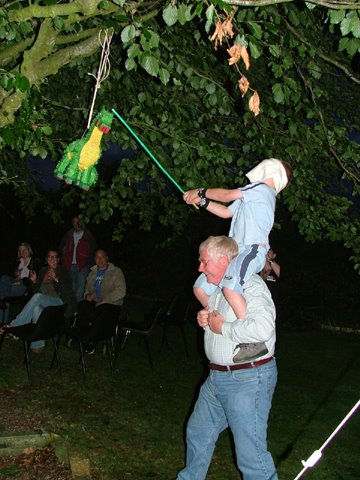
Gothboy lends a hand with Jessica's assult on the pinada

Jonathan McGowan's exhibition

Bob Morrell's exhibition

L-R Larry Warren, Nick Redfern, Corinna, Me, (kneeling) Lars Thomas

Me and Rich on stage

Rich tends the CFZ stall

The Quiz Team (Home) L-R Jo, Ross, Mark Martin

The away team: L-R Dr Darren Naish, Dr Lars Thomas, Jon Ronson

Richard masterminds the `Mad Hatter's Tea Party`

The Gambia expedition team take questions

Jeremy Harte is soooo rock & roll

The three boys wish me `happy birthday`

Lisa gives me Ross and Greg's birthday cake

The goatman cometh

Greg Phillips: "monsters are cool"

Weird Weekend 2006 - Speakers Dinner

L-R Suzi Marsh, Matt Osbourne, Helen Lester, Steve Jones, Richard Freeman, (top right, Ronan Coghlan and Tania Poole)

L-R Lisa Dowley, Suzi Marsh, Helen Lester, Steve Jones, Richard Freeman

L-R Darren Naish, Larry Warren, Jonathan McGowan, Nick Redfern

Lisa and Suzi

Weird Weekend 2006 - Picture Gallery

My surrogate Mum gets an `Access all Areas` pass

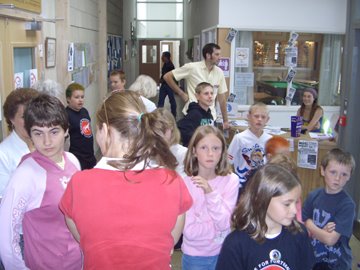
The village children certainly enjoyed themselves


My next door neighbour and young friend attack the pinada

Matthew Williams does his own inimitable thing

It's only rock and roll, but I like it


David Phillips - without him we couldn't have managed the event


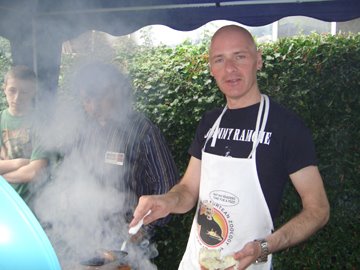
Redders mans the barbecue

Weird Weekend: The Final Day

I remember when I was a little boy, every Christmas, my little brother would burst into tears at the end of the day because it was all over for another year. At the age of nearly 47 I know exactly how he felt.

Saturday had been an extremely stressfull day; it had been a success, but there were 101 tiny issues (and one larger one) which had to be dealt with, and by the end of the day I was so tired that I could hardly walk, let alone think. But sunday was a delightfull day, an emotional rollercoaster which saw me almost burst into tears at one stage.

First up was Paul Vella. I have known Paul for years, and for the last three years he has offered to give a talk at the Weird Weekend, and to my eternal embarrassment I have forgotten to put him on the bill - until this year. I am not doubly embarrassed, because he was bloody fantastic! Although during the rest of the weekend, I had been fairly strict about keeping to the schedule, he was so popular, and engendered such an impressive dialogue with the audience, that his 45 minute talk lasted nearly an hour and a half - with absolutely NO complaints.

Then came Jeremy Harte, who told of the folkloric accounts of how monsters - mostly dragons and wildmen - had been captured by use of alcohol. His talk was particularly interesting, when, during the discussion on wildmen, a three way discussion between him, Ronan, and Richard F, took the audience by storm.

Chris Moiser gave an entertaining and informative talk about the mystery of the Wrangaton Lion, and explained how the recently introduced Freedom of Information Act has been an invaluable boon to British mystery cat researchers. Chris, by the way, has been the only speaker, apart from Richard Freeman, to have appeared at every Weird Weekend since we started.

Then came Larry Warren - one of the most eagerly awaited speakers of the weekend. Since arrived on Thursday he had quickly endeared himself to both the children and the adults of the village. He had been playing with the kids all weekend, and had also become a firm favourite up at the pub! His Rendlesham Forest talk brought the house down, and there are now North Devonians from the age of 8 to 75 who are devoted Warrenophiles.

Next up were C.A.S, a local band, put together by David Phillips, who works at the CFZ during school holidays and at weekends. They are all fourteen, and the line up were:

Tully Reynolds Vox
Chris Buse Lead Guitar
Richard Harding Rhythm Guitar
Jeremy Manning Bass
David Phillips Drums
George Snell Yeti

I gave them my best Sam Cutler introduction, and Matt Williams provided lasers and smoke, and for a brief three minutes, we were transported back to Woodstock!

But then came the surprise. I have known David's family for thirty-five years, and his mother, Kaye, is more like a sister to me than a friend. David grabbed a microphone, and together with his two young brothers Ross, and Greg, read me a poem they had written, and presented me with a birthday cake nmade by the two younger boys. It was then, for the first and only time onstage, that I very nearly burst into tears!

Then came Ronan Coghlan, someone without whom I cannot imagine evr having a Weird Weekend. He is opne of the most naturally funny people that I have ever met, and he was undoubtedly the most entertaining speaker of the whole weekend. His talk on the goatman legends around the world, from ancient Greece, to moderm-day America.

I wrapped up the proceedings with a few words on the activities of the CFZ over the last year, and what we hoped to achieve in the future, and then it was all over!

There are so many people that I would like to thank for their help this weekend. Apart from the speakers, there were the stage crew! When we started the Weird Weekend back in 2000, it was put together by me, Richard, Graham, and Nichola Sullings - a crew of four. Now, I had a crew of over twenty!

LISA DOWLEY: Security/Floor Manager
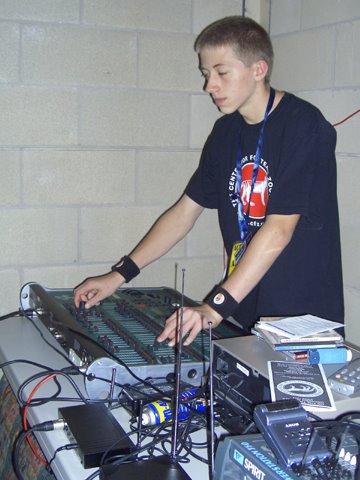
DAVID PHILLIPS: Sound and Light
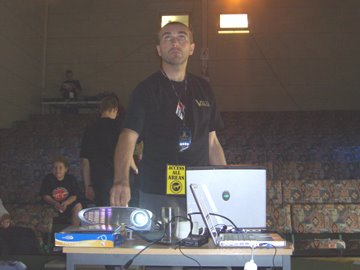
MATTHEW WILLIAMS: AV/crew
MATTHEW OSBOURNE: Road Crew
PETER CHANNON: Road Crew
JOHN FULLER: CFZ Staff/retail
MARK MARTIN: Security
JOHN GLEDSON: CFZ TV/First unit Cameraman
DAN GARRAWAY: CFZ TV/Second unit Cameraman
GRAHAM INGLIS: CFZ Management/Driver/Third Unit Cameraman
ROY PHILLIPS: Driver/crew
ROSS PHILLIPS: Floor Liaison
GREG PHILLIPS: Floor Liaison
OLL LEWIS: CFZ Staff/tour guide
NICHOLA SULLINGS: PA (Friday)
RICHARD FREEMAN: CFZ Management/Asst. Floor Manager (Friday)/Compere
MARK NORTH: CFZ Management/Photographer/Retail
CORINNA JAMES: CFZ Management/Retail/Admin
BRIAN BUTLER: Community Centre Liaison
HELEN BOND: CFZ Infrastructure
SUZI MARSH: PA/Admin/crew/retail

That evening in the pub, someone asked me what the point of the whole thing was. I told him that although it is the only English speaking cryptozoological conference in Europe, it is more than that. The CFZ is fast becoming a truly global community, and the Weird Weekend is the one time in the year that this community meets in the flesh. It is a place to see old friends, and to meet new ones. It is a place where people of all ages (3-80+ this weekend), all nationalities (11, this weekend), and from all walks of life can get together, have fun, and be happy.

In the modern world, occasions like this are a real rarity, and it truly has been a very weird (and heartwarming) weekend.