WELCOME TO THE CFZ BLOG NETWORK: COME AND JOIN THE FUN

Half a century ago, Belgian Zoologist Bernard Heuvelmans first codified cryptozoology in his book On the Track of Unknown Animals.

The Centre for Fortean Zoology (CFZ) are still on the track, and have been since 1992. But as if chasing unknown animals wasn't enough, we are involved in education, conservation, and good old-fashioned natural history! We already have three journals, the largest cryptozoological publishing house in the world, CFZtv, and the largest cryptozoological conference in the English-speaking world, but in January 2009 someone suggested that we started a daily online magazine! The CFZ bloggo is a collaborative effort by a coalition of members, friends, and supporters of the CFZ, and covers all the subjects with which we deal, with a smattering of music, high strangeness and surreal humour to make up the mix.

It is edited by CFZ Director Jon Downes, and subbed by the lovely Lizzy Bitakara'mire (formerly Clancy), scourge of improper syntax. The daily newsblog is edited by Corinna Downes, head administratrix of the CFZ, and the indexing is done by Lee Canty and Kathy Imbriani. There is regular news from the CFZ Mystery Cat study group, and regular fortean bird news from 'The Watcher of the Skies'. Regular bloggers include Dr Karl Shuker, Dale Drinnon, Richard Muirhead and Richard Freeman.The CFZ bloggo is updated daily, and there's nothing quite like it anywhere else. Come and join us...

Search This Blog

WATCH OUR WEEKLY WEBtv SHOW

SUPPORT OTT ON PATREON

SUPPORT OTT ON PATREON
Click on this logo to find out more about helping CFZtv and getting some smashing rewards...

SIGN UP FOR OUR MONTHLY NEWSLETTER


Unlike some of our competitors we are not going to try and blackmail you into donating by saying that we won't continue if you don't. That would just be vulgar, but our lives, and those of the animals which we look after, would be a damn sight easier if we receive more donations to our fighting fund. Donate via Paypal today...


Sunday, February 08, 2009

EXTRAORDINARY PHOTOGRAPH: Narwhal migration

This image was posted on one of the usenet newsgroups today. It is from a new BBC nature series called `Great Events`, and shows a pod of narwhals during their migration. Bob Rickard, founder of Fortean Times drew our attention to it, saying that it was a picture to "gladden the hear5t of any fortean" and we cannot but agree with him, and so we are posting it here to gladden your hearts as well..


GUEST BLOGGER OLL LEWIS: This shark, swallow UK whole

Apart from the fact that his puns are terrible and he has an obsession with the more surreal side of Internet culture, Oll Lewis hasn't put a foot wrong since we started this bloggo-thing. Because of his interest in things aquatic he has been co-ordinating the lake and sea monster news for the CFZ for some years now, and as regular readers of this bloggo will already know he is letting this obsession spill over online..

Ten years ago this summer the London’s press descended upon the Cornish seaside town of Padstow. The cause of this cockney cavalcade was the alleged sighting of a great white shark (Carcharodon carcharias) by local fishermen. The media circus stayed for a few days, perhaps expecting the bodies of half eaten swimmers to turn up on the beach and some ‘Jaws’ style panic to start among the holiday makers. They certainly geared up for this, the Sun’s article was typically over the top suggesting that it was only a matter of time before this 15 foot long killing machine started to devour surfers JUST LIKE THE MOVIE!!!

The shark was not seen again, the journalists got a few days at the seaside and a few stories and Padstow got a bit of free publicity, enticing more tourists to come to the picturesque town, every body won. As a result of this it has become almost an annual occurrence that sometime during the summer, when parliament is in recess and stories are thin on the ground, the newspapers will send a journalist or two to cover the latest sighting of a great white shark off the British coast. The cynic in me wonders why all the summer great white sightings seem to happen in nice little seaside towns in the South West and great whites are never seen in the sort of cities in the north that seem to fill most tabloid journalists with a sense of fear and dread. In recent years several of these sightings have been exposed as hoaxes including a film that showed film of a great white shark taken off the coast of Cornwall according to the fellow who sold it to the Sun. The same man revealed that this he had filmed the sharks off the coast of South Africa, not Cornwall, to the Daily Star a few days later.

It’s tempting to dismiss all this as just tabloid hyperbole, but could great white sharks really be living around the British coast? There is no reason why they couldn’t be, the nearest confirmed populations are only in the Bay of Biscay and British costal waters are warm enough for their survival, thanks to the warm waters of the Gulf Stream. Britain’s costal waters are also home to plenty of potential shark food (fish, pinnipeds and other aquatic mammals) and several other species of shark definitely feed around our coasts. However, just because a place would make a good habitat for an animal it does not necessarily mean that the animal is there. For example Indian Elephants would have little trouble surviving in Mexico, but geographical barriers mean that the species has never and, save for interference from man, never live in the wild in Mexico.

Eye witness sightings can be mistaken; many of the claimed great white shark sightings around our coasts are based on the fact that someone saw a large triangular fin jutting out of the water and assumed it was Jaws himself. This can account for the majority of sightings but not for the 1999 Padstow sighting. The shark was seen by a party of experienced fishermen, who would certainly be able to see the difference between a great white shark and other large sharks and marine mammals they would encounter regularly in the area. The fishermen were able to get a very good look at the shark and accurately estimate its size because it came within five foot of their boat. One large species of shark they would certainly be familiar with would be the porbeagle shark, a large porbeagle would be landed a little way along the coast from them near Boscastle in 2002 weighing 484 lbs (219.5 kg). One of the fishermen, Mike Turner, had even been a fisherman in South Africa, where he would have regularly encountered great white sharks.

Other possible evidence of great white sharks around the UK coast surfaced in late December 2007 when a lifeboat crew in Sherringham, Norfolk found a gory surprise waiting for them on their slipway; a freshly killed grey seal with a huge chunk bitten out of it. The seal had been bitten from the underside and serrated tooth marks were seen in the wound. Close up photographs of the wounds were examined by Dr Ken Collins of the National Oceanography centre in South Hampton, who confirmed that the bite was likely to have been made by a large shark that came in fast and attacked the animal. Dr Collins said a great white shark was one of a very small list of possible suspects, and not one that could be discounted.

Looking at the evidence it seems that great white shark do inhabit the costal waters of Britain, but are not here in large numbers. Personally, if I was taking a swim in the seas off Britain I’d be more concerned about pollution than great white sharks.


SOMETHING SINISTER IN THE BATCAVE

We received an email this evening from a chap called George Clappison asking us whether we had heard about something called `white nose syndrome` which has been described as the greatest threat ever to bat populations in parts of the United States.

We had, vaguely, but sent Max Blake to investigate further..


Something wicked this way comes. Every so often, an infection or disease comes along, spreads like wildfire and decimates its host species. Examples include the transferable cancer which affects Tasmanian Devils, and this, White Nose Syndrome, a fungal disease attacking bats, whose effects include white fungal growth around the nose area, and death, probably from starvation. Pups are falling more often from the cave roof where WNS is in residence, adding further numbers to the total. New York, Vermont, Connecticut, Pennsylvania, New Jersey and Massachusetts are currently the six US states affected by the fungus. The death percentages in different sites vary from 80-100% mortality, a horrific total. A number of bat species are affected, including the Indiana bat, which is protected by the Endangered Species Act.


Scientists have no idea if the fungus is transferred by bats, or by people; that little is known about it. It could be being transferred by cavers, but this is not certain. Spring and summer are the prime times for bat activity: these states will have an absence of bats twittering in the sky. Good news for flying arthropods though I guess...
This is the government website responding to WNS

http://www.fws.gov/northeast/white_nose.html


This is the National Speleological Society website regarding WNS

http://www.caves.org/WNS/WNS%20Info.htm

GUEST BLOGGER OLIVIA McCARTHY: Mammoth body art

When I was a boy in Hong Kong, the local TV Channel used to show the Bing Crosby Christmas show at various completely inapproproate times of the year, and I always remember how the Crosby clan used to sit around the open fire, roasting chestnuts and looking highly embarrassed as Bing would introduce each of them in turn to do some sort of party peice. I have become posessed by the spirit of Bing.

Because each time that one of my family comes to visit I inveigle them into doing a guest bloggo. Last week it was my darling eldest step-daughter Shoshannah, and this week it is the bloggo debut of my darling younger step-daughter Olivia, who has become fascinated by yesterday's mammoth tusk story, and - not entirely to my surprise - has her own inimitable take on it. Aren't you all agog to see what happens when my brother the vicar comes to stay?

So apparently, some time last year (brilliant accuracy, that) a guy named Johnny found a 14ft mammoth tusk after it was washed out of a permafrost (I had to Google what that was, I don’t know these things.. if anyone else is as clueless as I am, ‘permafrost’ is soil at or below the freezing point of water for two or more years) during a flood.
A lot of you will have seen the picture already, but, because I’m a really generous person, I’ll show you again:

Now, that’s an effing big tusk.

Anyway, it’s always nice to know that certain things remind certain people of you.. perhaps a song or a location. For example, my delightfully insane stepdad, Jon Downes (some of you may have heard of him!) saw this picture of a fossilised mammoth tusk and thought of me.

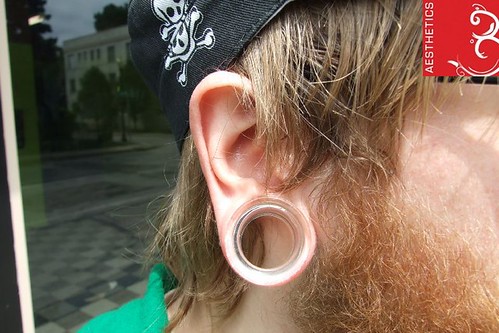
Why, you say? Short answer: because I have piercings. Long answer: Some of them are stretched (I currently have 7.1cm worth of metal/air through my flesh) and sometimes I wear jewellery made of water buffalo horn/bone. Before I get the animal rights debate thrown at me – the jewellery comes from water buffalo that are already dead. Jewellery (ie hand-carved necklaces, earrings and jewellery for stretches) is made so as not to waste any part of the animal. Good jewellery companies will source their materials legally and ethically.

Anyway, back to the whopping great tusk that that bloke up there is holding. Those of you with stretched piercings (Google images gives some brilliant examples: hurrah and woo and cartilage!) might well own some plugs/tunnels made from buffalo horn or bones. However, how many of you own jewellery made from fossilised mammoth ivory? If you do, I’m jealous. Some of this fossilised ivory jewellery can sell for around 500 US dollars per pair. Worth every penny/cent, in my opinion.

Jewellery makers take regular trips to Indonesia, and other countries, to source the fossilised tusks from antique shops, where it was (in most cases) previously used by tribal peoples for ice picks and other tools. The work that goes into making this jewellery is astounding – they are all hand carved and they are beautiful. Check out the ‘Mammoth Stock Designs’ from this company http://www.diabloorganics.com/.

My general aim in life is to own jewellery made from fossilised mammoth ivory. Yes, I aim low.. but then I’m more likely to succeed than those of you that wish to be astronauts or Santa.

And thus this rather poorly written blog entry was born.. all because when my stepdad sees pictures of fossilised mammoth tusks, he thinks of me wearing such a thing through a hole in my ear. Huzzah!


GUEST BLOGGER RICHARD HOLLAND: Animals that aren’t

Once again we hand you over to guest blogger Richard Holland, editor of Paranormal Magazine, and all round good bloke. He intends to be a regular visitor tho these pages, and I am sure that you will all agree with me that this will be jolly good news for all of us..


I’ve had a few communications now from readers of my Paranormal magazine concerned that it has become overly biased towards cryptozoology. Although this is something I’m prepared to address, I am surprised to find that readers seem to consider anything which apparently bears fur or feathers falls under the remit of the cryptozoologist.

In the current issue there is an article by Janet Bord – who first highlighted the concept of ‘animals that aren’t’ in her (and Colin’s) 1980 book Alien Animals – on winged humanoids. And Jon Downes – who came up with the nattier phrase ‘zooforms’ for the same thing – writes a review of the British star of that particular show, the Owlman. In a previous issue Janet recounted some of the more outrĂ© features of some Bigfoot stories: glowing red eyes, telepathy, impervious to bullets etc. I consider none of these articles to be on the subject of ‘cryptozoology’. Not even crypto-cryptozoology.

Clearly it’s the duty of the cryptozoologist to take a peek at such stories just to make sure there isn’t anything there to interest him/her. But although they might feel that Owlman was just a sighting of a big owl which freaked out a couple of kids creeping round a creepy church at twilight, or that Mothman was just a big crane that swooped on a car, and that both yarns grew in the telling… it’s not really their place to go on about it. Officially, I mean. It’s not really their job. Once glowing eyes and human morphology and sudden disappearances and bullet-proof skin etc etc become part of the description, surely it’s time for the cryptozoologist to move on? By all means chase after Thunderbird: if it exists, it’s a bird (or better still a Pteranodon). But Mothman?

The other way round is OK: looking at the folklore of exotic peoples in exotic places to determine whether some of their mythology may refer to undiscovered exotic beasties. The hoped for result in those cases is something zoological, not parasychological: something of flesh-and-blood you can give a Latin name to (preferably one incorporating your surname!).

The reason I highlight this is that there is a danger of the very proper study of Cryptozoology becoming confused – yea verily, polluted – with Spookology (a term I’ve just coined and now feel rather fond of). Batsquatch is not an indigenous species of North American ape that’s also evolved big bat wings so that it can fly up and pick the choicest bananas from the equally undiscovered North American banana tree. And Black Dogs aren’t black dogs (except when they are, in which case, who cares?). They are SPOOKS, fit only for the attention of the Spookologist.

And let’s face it if you trekked into some steaming jungle hoping to find an unknown species of big lizard only to find yourself confronted by some supernatural monster that was on a spree from Yoh-Vombis or Unknown Kaddath you’d crap yourself.

And no zoo would take it. (Shamblerfromthestars freemaniensis anyone?)
Over, once again to the divine Ms F. Charming as usual, she is taking up cudgels on behalf of an obscure little wading bird that looks set to go extinct without anyone really noticing....


The thing I noticed quickly when researching about this little bird is that whilst most places described the Great Auk as the last European bird to become extinct when really it was the Canary Islands Oystercatcher in 1981. The Slender Billed Curlew (Numenius tenuirostrisis) in danger of joining this bird, with no one noticing and many people not caring.

Websites would probably still say it was the Great Auk that went most recently.

This Curlew is a bit of a mystery bird, its breeding grounds are still unknown although it is thought they are in Siberia somewhere, Siberia being a big place there is still hope that their breeding grounds are in a place humans have not yet taken over.

The other big mystery is why they are in such decline, of course the usual suspects of habitat loss, hunting and egg-collecting (the bane of such rare birds) apply, but these curlews were fairly common even in the 19th and early 20th century, into the 1970’s flocks of 100 birds were recorded. Perhaps one of their food sources have vanished, or maybe the dwindling gene pool had a catastrophic effect.

The curlew shares unfortunate characteristics with the Dodo, it is a plump bird and one which is not normally inclined to flee from humans, along with being tastier than the unlucky Dodo this means that hunters (even those who do not know what the bird is) find it an attractive target. One such hunter coming upon the hidden breeding grounds could wipe out a huge percentage of any remaining birds.

The thought of the slender billed curlew vanishing forever is a dreadful one, not least to those who have actually seen it. Simon Barnes in an article for The Times said – “It doesn't feel right. I really don't feel happy about the possibility that I have seen a bird that is now extinct. Well, it is not right that any one should, but since it's me that saw it, on a brief but rather dazzling trip, the whole thing has become oddly personal. I feel almost guilty: as if I shouldn't have seen it, as if my viewing of it somehow contributed to its downfall.”

Seeing a species that may become or may already be extinct brings home the reality that once the last one has gone there will never be another. And that the disappearance of even this one little wading bird is as much a tragedy as the death of the last Great Auk

Wikipedia Factfile: The Slender-billed Curlew, Numenius tenuirostris, is a critically endangered bird in the wader family Scolopacidae. It breeds in marshes and peat bogs in the taiga of Siberia, and is migratory, formerly wintering in shallow freshwater habitats around the Mediterranean.
This species has occurred as a vagrant in western
Europe, the Canary Islands, the Azores, Oman, Canada and Japan. The only time it was seen in North America was in Crescent Beach, Ontario, Canada in 1925.


CFZ PEOPLE: The world welcomes Emma Naish


E-mail from Darren Naish received late last night: "I am very happy to report that Tone and I have a beautiful, perfect baby girl: little Emma. Emma arrived at 9-43 on Saturday morning (Tone's contractions started at about 5am), and - despite the recent bad weather and treacherous driving conditions - we had a totally uneventful trip into the hospital with no danger from ice. So far Emma has done an awful lot of sleeping. I am still somewhat bewildered by the whole ordeal, but very very happy to be a dad twice-over. "

Congratulations and much love to Darren, Toni, baby Emma, and Will (Emma's big brother)