


 Yesterday's trip out was a peculiar, though eventful one. I had a doctor's appointment, and as I didn't want to have to rush my blogging activities I did the blog on the previous night before going to bed. This is where the time tenses get a little confusing.
This is being posted on tuesday morning, but I am writing it on monday afternoon and early evening. The events covered took place on monday lunchtime and early afternoon. But I have just described how I wrote and posted monday's blogs late on sunday night (US time) and very early on monday morning (UK time). Confused? I am.
Prudence decided that she wanted to take us all for a walk, so I decided that we should go to Northam Burrows, a place of which I am rather fond. Now, those of you of a literary bent have certainly heard of Rudyard Kipling, and may well have read Stalky and Co which is his account of his schooldays at the United Services College in Westward Ho! Many of the stories are set on land owned by the Royal North Devon Golf Club, which is where we were today.

 The first and most significant thing about the day was that we saw loads of curlews. I have seen the odd one here and there, mostly on Northam Burrows, over the years, but I have never seen so many in one place before. I have also seen them on Dartmoor, which is peculiar, because according to the RSPB Dartmoor is one place where they cannot be found.


We also saw a jolly little family of (what I am 99% sure are shelducks), which as I cited Rupert Sheldrake only a few days ago (and I think I am being spectacularly inept here, because I can't remember where I did it) is a mildly amusing ornithological lexilink.

Herewith, two herring gulls and a black headed gull...


But I am not sure what these three are. Please note: I am not making any claims that I have discovered a new species of the Laridae on Northam Burrows. Of course I haven't. I think that one of these (the one at the top) is a juvenile black headed gull, and that the right hand one below is a juvenile herring gull, but I am far from sure. Any ideas?

 The eagle eyed amongst you will remember that at the start of this post Ialluded to more than one significant discovery today. That is true. The second significant discovery is that Prudence doesn't like horses. Whether it is her ancestral bull-baiting genes coming out, and she thinks that all ruminants are there to be disembowelled, or whether it is just that she had led a sheltered life before coming to live with us, and because she had spent most of that life walled up in a concrete kennel in a puppy farm she had never had the chance to meet any before, but she certainly doesn't like them.
The long and the short of it is that she saw several horses being ridden along the road as we approached the Burrows, and she was obviously of the opinion that they were dangerous wild beasts of the sort that a well-bred young lady with impressive jowls should have nothing to do with. So she barked and growled and was reprimanded by her owners. She was over excited by the time she got to the Burrows, and whilst the walk calmed her down a bit, she was still in a bit of a tizz by the time (just as she and Corinna were climbing The Pebbleridge) she saw a sprightly young whippet and started to bark, growl and strain at the leash. Whether she wanted to play or to eviscerate it we shall never know, because she pulled Corinna down, and she fell over on top of her, leaving her mistress bruised and cross.
Prudence was duly chastised and we drove home in silence!
There are actually mildly cryptozoological aspects to Northam Burrows. Three of them to be precise:
Firstly according to The Transactions of the Devonshire Association sometime during the 1940s, there was a dog living wild on the Burrows for some years. This is quite unusual because although there are hundreds of thousands of feral cats, the numbers of feral dogs are seriously limited - in the UK at least. Sadly it succumbed to a landmine.
Secondly, back in the early 1970s, I saw a flamingo standing, minding its own business, in the middle of The Mere - the body of water in the top photograph below.
The other, and potentially more interesting animal of cryptozoological interest is a small fish called the three spined stickleback.
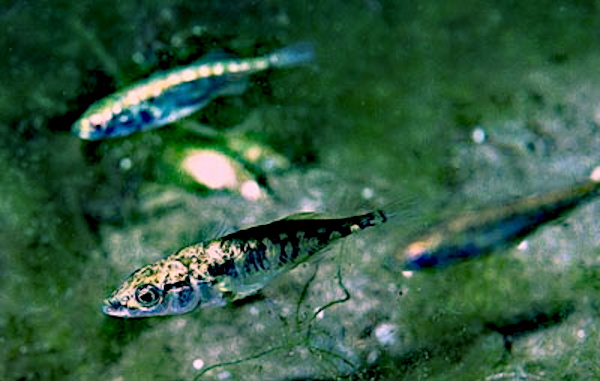
Charming little fish, they were once upon a time kept in makeshift aquaria by every small boy with an interest in the natural world. I was no exception. Back in 1974 I put together a display of freshwater creatures from North Devon for a school project, and was interested to find that the sticklebacks that lived in the small streams which crisscrossed Northam Burrows were much darker and more compact than their cousins from the ponds around Bideford.
Wikipedia, from where I pinched the above picture BTW, notes that:
"Freshwater populations are extremely morphologically diverse, to the extent that many observers (and some taxonomists) would describe a new subspecies of three-spined stickleback in almost every lake in the Northern Hemisphere.".
I would not go so far as to propose a new subspecies, but I think that there are certainly grounds to suggest a new colour morph. However, and here is the HOWEVER...
I haven't seen any of these darker fish for 38 years, and I have no idea whether they still live there. My mobility is not what it was, and so - if there are any enthusiastic young amateur naturalists from North Devon reading this - get in touch with me. I have a nice project for you for your next school holidays.
So - all in all - an eventful day, and one which I think we shall be repeating very soon. Hopefully Pru will be behaving better next time around. If not, it is rolled up newspaper time.





 Posts
Posts


