


Ages ago I wrote a post about the sad story of Lady Eleanor Glanville:
Quincemothman commented the other day:
Yes, I can understand how this fascinating woman must have felt at times. I have photographed the Glanville Fritillary, its underside is quite spectacular. I've composed a piece of music named after her ( Lady Eleanor Glanville ) on chord zither, you can hear it on YouTube, quincemothman.
So here it is...
Showing posts with label lepidoptera. Show all posts
Showing posts with label lepidoptera. Show all posts
Sunday, January 05, 2014


Friday, June 15, 2012
Monday, August 23, 2010
INACHIS IO IN THE HOUSE
 Earlier this year I bemoaned the fact that I hadn't seen a peacock butterfly in years. Then this morning as I staggered downstairs demanding lemsip and trying not to let the dog trip me up, I saw something flapping against the window panes of the office. Guess what!
In my cold-befuddled state, I didn't think of taking a photograph as I netted it and released it into the garden, so this one taken by Mark North at the WW will have to do.
Thursday, August 05, 2010
YOU DON'T GET OW'T LIKE THIS IN PELSALL
 Jonny, I photographed this butterfly yesterday (pic attached) in our garden. If I said he was as big as a sparrow I wouldn't be exaggerating! Best Nick
I think it is an American black swallowtail (Papilio polyxenes) but wouldn't mind that being confirmed..
Tuesday, July 27, 2010
JASON COCKBURN WRITES
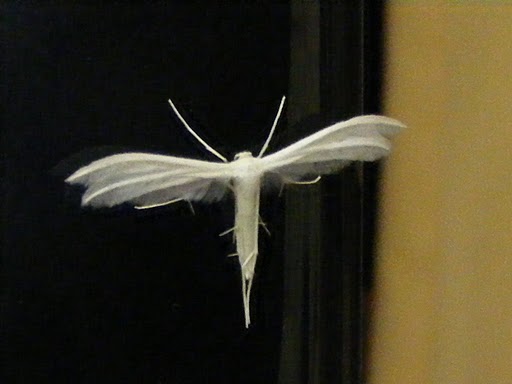 Jason writes: 'do you know what this insect is? Its been in my room the last two nights.'
I actually do know for a change. It is one of my favourite British lepidoptera, but let's see if you guys out in Bloggoland can match my knowledge?
Friday, February 05, 2010
NOT MY BLACK SWALLOWTAIL
 From the latest edition of the Entomological Livestock Group newsletter, a letter from veteran British entomologist Brian Gardiner:
On E-bay in January appeared an offering of "British Swallowtail. P. machaon Britannicus, Black Ab." which had a data Tag "Cambridge 1968, B.O.C. Gardiner. I can categorically state that I never bred or possessed this specimen which from the accompanying photograph appears to be the North American Papilio polyxenus. When I did breed P. machaon, for release onto Wicken Fen in the 1950`s (see The Countryman 1960 vol 57 pp 294-298) all retained reference specimens would have the label `ex Norfolk stock.’ so I suspect the 1968 Cambridge label has been taken from one of my many hundreds of P. brassicae specimens which I widely distributed and would have had a Cambridge label.
The specimen in question was offered by mustavit-2007 with the item number 380196740377 and is still view-able for anyone to take a look on Ebay. The specimen sold for £255 which I think is a lot for what I think is a common American Swallowtail! There have recently been a
number of lepidoptera on Ebay with some dubious attributions, with the data labels, like mine, not being recognised as attributed to the specimen in question, so it is a case of ‘caveat emptor’ if you fancy any of them. Brian O. C. Gardiner.
number of lepidoptera on Ebay with some dubious attributions, with the data labels, like mine, not being recognised as attributed to the specimen in question, so it is a case of ‘caveat emptor’ if you fancy any of them. Brian O. C. Gardiner.
Thursday, October 22, 2009
BUTTERFLY CONFERENCE NEWS
The 2010 target and beyond for Lepidoptera.
Reading University, 26-28th March 2010
www.butterfly-conservation.org/symposium
Deadline for paper abstracts 2nd November.
The proceedings will be published as a book and special issue of the Journal of Insect Conservation.
A discount is available for all bookings made before 8th January 2010.
Sessions will include
· 2010 assessments for Lepidoptera from around the world
· The science of conservation management
· Practical habitat management
· Landscape scale conservation
· Climate change impacts and adaptation
· Future challenges
The Symposium will be opened by our President, Sir David Attenborough.
Keynote speakers include: Prof. Jeremy Thomas (Oxford Univ), Sebastian Winkler (IUCN, Brussels), Chris van Swaay (Dutch BC), Scott Black (Xerces Soc, USA), Dr Tim New (Australia), and Prof. Chris Thomas (York Univ).
There will be a linked one-day conference before the Symposium on 25th March focussing on the management of woodlands for butterflies, moths and other wildlife. This can also be booked on the Symposium pages of the website, either together or separately.
Friday, July 03, 2009
WANTED BY THE BBC: HOLLY BLUE CATERPILLARS
 Celastrina argiolus
The BBC Natural History Unit is currently making a 60min programme devoted to British Butterflies and would love to obtain Holly Blue caterpillars, either captive bred or collected from the wild that we could film pupating and emerging later this summer. If you can help please call 0117 974 7855, or email simon.bell.01@bbc.co.uk
Wednesday, June 24, 2009
ANOTHER ONE FOR DR DAN
 Hannah writes: I spotted this beastie this morning in our Garden in Northamptonshire UK. It was approx. 2cm long and I did manage to get a photo.
What is it? I'm pretty sure I know, but do you?
Sunday, June 21, 2009
WHITE ERMINE
 When I was a boy and lived in the same village where I find myself living now, I was always obsessed with lepidoptera and one of the most fertile spots for hunting said creatures was not the hedgerows and fields; not the lanes and woodlands but the wall of the village shop.
The village shop (which in those days was owned by a couple called Paddon), had (and indeed still has) whitewashed walls and there are two large street lamps, which cast great pools of light upon the walls.
These used to provide a perfect moth trap and each morning, as I queued up outside the shop for the school bus, I would check the walls for moths. The most common was this: the white ermine (Spilosoma lubricipeda). This chunky medium-sized moth is allegedly quite common over most of Britain, and produces hairy caterpillars that eat a variety of weeds and garden plants, and I have always thought of it as being one of the species that is synonymous with Woolsery.
The only trouble is that I haven't seen one here for years. Although I check the walls, the village shop no longer acts as an attractor for moths and although other species (a considerably smaller viaiety, however) still glide silently across the North Devon night, there ain't no white ermines and I have grieved the fact for the past four years.
Then, once again, Greg came to the rescue. Greg is my ten year old Godson who, unlike so many boys of his age, still catches butterflies and moths (although his collection involves a digital camera rather than a setting board). Greg was the first to photograph one of the painted ladies a few weeks back and now he is the first to catch, photograph and release white ermines. Thank you Greg, my dear. You have restored my faith in nature, both human and otherwise....
Friday, June 12, 2009

Tuesday, June 02, 2009
LATEST NEWS FROM SMALL TORTOISESHELL RESEARCH PROJECT
 The picture is by Maxy, and the text is taken from the latest issue of the Entomological Livestock Group Newsletter:
Thanks to all the ELG members who helped us to our research into parasitoids of Small Tortoiseshell and Peacock butterflies in 2008. Our research focused particularly on the arrival and spread of a 'new' tachnid fly, Sturmia bella, from the continent since 1998. We would like to ask for your help again in 2009 as our research continues. Some of the data from the 2008 are still being analysed, but a report of the main results can now be downloaded from our web site at the following address:
- To summarise:
* Small Tortoiseshells have declined by approximately 50% in the past decade
* Sturmia bella now has a wide distribution in southern Britain, at least as far north as Merseyside and Doncaster.
* Small Tortoiseshells have declined most dramatically in southern Britain but have
been declining in northern England and Scotland too.
been declining in northern England and Scotland too.
* Sturmia bella is now the major parasitoid for Small Tortoiseshells (but not Peacocks)
* Sturmia bella is mostly recorded from caterpillars collected in late summer.
* Sturmia bella is an additional cause of mortality to the larval batches it parasitizes and may now be competing with native parasitoids.
* The overwintering strategy of Sturmia bella in the UK is still unknown.
* There is no evidence that local decline rates reflect the presence of Sturmia bella, but sample sizes are small.
Caterpillar samples of Peacock or Small Tortoiseshell collected from the same location as last
year would be extremely valuable, but we are also interested in samples from new sites. Samples from northern England and Scotland would be especially welcome.
year would be extremely valuable, but we are also interested in samples from new sites. Samples from northern England and Scotland would be especially welcome.
Instructions and recording sheets (slightly updated since last year) are available at the project web site. Dr Owen Lewis & Dr Sofia Gripenberg, Department of Zoology, University of Oxford (Email: sturmia.bella@googlemail.com )
Saturday, May 30, 2009
MORE ON THE PAINTED LADY MIGRATION
 The following, compiled by Paul Batty, is taken from the latest edition of the Entomological Livestock Group monthly newsletter which arrived in my e-mail inbox this morning:
PAINTED LADY MIGRATION (C.cardui):
Since the first news of the mass northwardly migration of cardui, mentioned by Neil West & others in France & Spain, theweather has been poor here in the UK, but it's improved a little and reports from all over the UK are now coming in.
Sunday 24th May was a very nice day here and the migratingPainted Ladies had reached central England - Barry Ottewell reported seeing a dozen or morepassing through his garden near Melton Mowbray, Leicestershire. Since then, dozens of reports have been coming in.
Tim Jenkins writes... "Re. Painted Ladies I have seen a dozen plus in Coventry, all belting northwards without stopping".
Andy Green writes... "Single Painted Lady in my Garden at Little Sutton Lincs. 26th May but no Red Ad's yet.".....
Rupert Witherow e-mails.... "Painted Ladies - At Bucklebury between Reading & Newbury yesterday, 25May, in one field I counted 4-6 per minute non-stop throughout the afternoon from 1300-1730and still going strong then. Sometimes it got up to 10+ per minute. Mostly singles, butsome in 2's & 3's. Only occasionally one would stop to refuel, but a whole field of buttercups and other wild flowers was completely ignored. All flying due North and really steadily".
David Longdon wrote.... "Painted Ladies flying through North Norfolk today heading towards the coast literally hundreds - its going to be a bumper year I hope" (24th May).
Also from Norfolk, Andrew Freebray mails..... "Further to our colleagues reports in the ELG list a couple of issues back regarding the migration of Vannessa cardui (Painted Lady) through France, I wonder if any other member witnessed today's migration. It is Sunday (May24th) and after watching the Monaco Grand Prix on the TV (well done Jenson!) I sat out in my back garden in mid Norfolk and in a strip of approximately 20 yards wide and bounded byhigh sycamore trees I noted 131 cardui between 3.20 and 3.45pm after which I gave upcounting. The butterflies were all flying North at a height of between 20 and 40 feet and the migration continued at much the same rate until 5.15pm with only a few stragglers thereafter. Given my somewhat restricted viewing theatre the mind boggles at the possible numbers of this butterfly flying over Norfolk today and should we be blessed with a decent Summer this may turn out to be a cardui year".
Phil Lewis writes..... "Have seen at least 3 today in Abingdon and Oxford - good news!!!"
Terry Sparks writes... "For the record, 5 Painted Ladies passed through my garden in north Wiltshire in just over 1 hour thismorning - 24th"......
Malcolm Beeton tells us there were "Six painted ladies yesterday morning Sunday 24th May! on a lavender bush in Bushey Hertfordshire at 09.30 am."......
Tim Huggins adds.... "On Sunday morning in Diss, Norfolk I watched C.cardui streamingthrough a friends garden. I lost count but reckon they were going through at numbers in excess of 100 per hour. It was very purposeful, contour-hugging flight at 5 - 15 ft above ground level and all heading N/NW, a bearing that will probably take them to Scarborough!".
Pete Friedrich writes.... "There's Painted Ladies by the shedload in my neck of the woods - it's been a spectacular sight seeing them covering the Ceanothus bush and Red Valerian in my garden during this weekend" - [Clacton, Essex].
David Longman (Southampton) sent me a text (Yep, Batty does have text from time to time) to say that there were loads of P/L's passing through that afternoon (25th) six at a time and the odd Silver Y (Autographa gamma).
Mark Jenkins writes.... "Loads of Painted Ladies in Buddleigh Salterton Devon, at the weekend, coming in off the sea, feeding on the plentiful Valerian in town and on the cliffs.Also fair numbers seen when travelling back to Dorset in the early evening." Many, many more sightings.... If I've not mentioned yours, sorry...
I and my colleagues here on the CFZ bloggo sincerely suggest that you join the Entomological Livestock Group. It is a massively worthwhile thing with which to be involved:
A GOOD REASON WHY ALL CRYPTOTYPES SHOULD SUBSCRIBE TO `THE ENTOMOLOGISTS RECORD`
 ANTHENE GEORGIADISI SP. NOV. (LEP.: LYCAENIDAE) – ANEW BUTTERFLY FROM LIBERIA
TORBEN B. LARSEN
Jacobys alle 2, 1806 Frederiksberg C, Denmark (torbenlarsen@btinternet.com)
Abstract
Anthene georgiadisi sp. nov. is described as a new species in the difficult complex of the “ red Anthene”, in West Africa closest to A. mahota Grose-Smith, 1887.
It is the smallest species in the complex. The type locality is the newly created Sapo National Park, one of the largest and most important protected areas in West Africa.
Anthene georgiadisi sp. nov. was among 150 species collected during a brief visit by a non-specialist collector, emphasizing the need for continued intensive collecting in the dwindling forests of West Africa.
Friday, May 29, 2009
Richard Muirhead (slight return): Reedwolves and swarming blues
 Richard Muirhead is an old friend of the CFZ. I have been friends with him for 40 years now, since we were kids together in Hong Kong. He is undoubtedly one of the two best researchers I have ever met; he and Nigel Wright both have what Charlie Fort would have no doubt called a wild talent; a talent for going into a library, unearthing a stack of old newspapers, and coming back with some hitherto overlooked gem of arcane knowledge. Twice a week he wanders into the Macclesfield Public Library and comes out with enough material for a blog post.
However, as you may have guessed his natural habitat is the library. This past few weeks, for the first time since I have known him, he has been out in the field doing research. He has been working with a butterfly conservation organisation in Hungary, and whilst he was out there he has carried out a few cryptozoological tasks for us.

He telephoned the other day, excitedly telling me aboiut a swarm of blue butterflies he had seen; well over a thousand silver studded blues (Plebeius argus). Such swarms used to be common in Britain, (as you can see from the second extract this week from L Hugh Newman's seminal Living with Butterflies (1967) which is posted on the left.
However, to the best of my knowledge they have not been seen in Britain for many years, so Richard was unsurprisingly excited.
But it wasn't just butterflies that attracted his attention. About ten minutes ago he telephoned me from a train just outside Brussels - he is on his way home, and he said that he had some interesting news about the reedwolf, about which I first read in Karl Shuker's Extraordinary Animals Revisited. Karl wrote:
"The Hungarian reedwolf was a small, mysterious form of wild dog existing in Hungary and eastern Austria until the early 1900s. In 1856, M. Mojsisovics named it Canis lupus minor, treating it as a small wolf, but the precise nature of its identity remained a debated issue long after that. In the late 1950s, this extinct enigma inspired a series of interchanges in various journals between Hungarian researchers Drs Eugen Nagy and János Szunyoghy. Nagy staunchly supported Mojsisovics’s reedwolf classification, but Szunyoghy categorized it as a larger-than-normal version of the common jackal (in 1938, Dr Gyula Éhik had actually renamed it C. aureus hungaricus). However, the detailed studies of Prof. Eduard-Paul Tratz with the handful of museum specimens of reedwolf in existence provided persuasive evidence for believing that it had been an unusually diminutive race of wolf after all, an identity that has since won widespread acceptance."
It was difficult to make out what Richard was saying. There were train noises, crackling sounds, and he was on a mobile 'phone three countries away, and I am going deaf. But it appears that the controversy continues, over whether it was jackal or wolf, and also that the use of the past tense is not really justified. For, as far as I can gather, sightings continue to the present day.
More news when I get it (and BTW, Richard asked me to tell you all that Muirhead's Mysteries will be back next week)
Totally coincidentally, our new buddy Scotty Westfall over on the Wildlife Mysteries blog which gets better and better each day, has just published an article on the reedwolf which can be found at the link below:
Monday, May 25, 2009
SWEET PAINTED LADIES
 Paul from the Entomological Livestock group
wrote last night:
The migration of Cynthia cardui has reached Melton Mowbray (I've just been informed) with around 10 individuals spotted, heading north.... and verystrong numbers still flying north through France, 100 per hour near Paris and Nantes.
As I type, you should be seeing good numbers in southern England and with luck, we shaould have them here in the capital (Sheffield) by tomorrow.
I have always found mass migrations of butterflies interesting, and in these sad days when our own native species are becoming more and more impoverished, often as a result of misguided or stupid action on a local governmental level, these mass migrations will seem ever more spectacular. If anyone has pictures of these wonderful creatures in their garden this year please send them to me.
The fact that such delicate creatures fly to our shores each year all the way from the deserts of North Africa is something that I find absolutely enthralling.
 This excerpt on the left is taken from the chapter called `Mysteries of Butterfly Migration` in one of my favourite books L. Hugh Newman's Living with Butterflies (1967).
I would have normally typed it out, but I wanted to try out the new scanner that dear Emma donated to the CFZ. I am a notorious technophobe (although nowhere as bad as Richard F who is a complete Luddite to a ridiculous degree), and I am feeling quite proud of myself for having worked out how to use it in a compltely calm and unworried manner. But that is another story..
In the last few years the migratory butterflies seem to have arrived on these shores pretty well as usual. It will be interesting to see, with the changing weather patterns, and most importantly with the considerably improved weather that we have seen this year, whether they will start to breed in the manner that they did back in the good old days.
For more information see this site:
http://www.plantpress.com/wildlife/search.php?name=&pl=5&adv=1&ot=&r=0&g=42225&p=3&o=366
Saturday, May 23, 2009
THIS HAS GOT TO BE THE RAREST BUTTERFLY EVER

This picture has been shamelessly stolen from the latest edition of the Bulletin of the Amateur Entomological Society.
It is one of the illustrations from a fantastic article on halved gynandromorphs, but this has to take the biscuit; a halved gynandromorph large copper.
This is the equivelant of having a first issue PennyBlack with a misprint showing Queen Victoria smoking a suspiciously long cigarette whilst wearing a rasta hat!
Wayhay!
Subscribe to:
Posts (Atom)



 Posts


