WELCOME TO THE CFZ BLOG NETWORK: COME AND JOIN THE FUN

Half a century ago, Belgian Zoologist Bernard Heuvelmans first codified cryptozoology in his book On the Track of Unknown Animals.

The Centre for Fortean Zoology (CFZ) are still on the track, and have been since 1992. But as if chasing unknown animals wasn't enough, we are involved in education, conservation, and good old-fashioned natural history! We already have three journals, the largest cryptozoological publishing house in the world, CFZtv, and the largest cryptozoological conference in the English-speaking world, but in January 2009 someone suggested that we started a daily online magazine! The CFZ bloggo is a collaborative effort by a coalition of members, friends, and supporters of the CFZ, and covers all the subjects with which we deal, with a smattering of music, high strangeness and surreal humour to make up the mix.

It is edited by CFZ Director Jon Downes, and subbed by the lovely Lizzy Bitakara'mire (formerly Clancy), scourge of improper syntax. The daily newsblog is edited by Corinna Downes, head administratrix of the CFZ, and the indexing is done by Lee Canty and Kathy Imbriani. There is regular news from the CFZ Mystery Cat study group, and regular fortean bird news from 'The Watcher of the Skies'. Regular bloggers include Dr Karl Shuker, Dale Drinnon, Richard Muirhead and Richard Freeman.The CFZ bloggo is updated daily, and there's nothing quite like it anywhere else. Come and join us...

Search This Blog

WATCH OUR WEEKLY WEBtv SHOW

SUPPORT OTT ON PATREON

SUPPORT OTT ON PATREON
Click on this logo to find out more about helping CFZtv and getting some smashing rewards...

SIGN UP FOR OUR MONTHLY NEWSLETTER


Unlike some of our competitors we are not going to try and blackmail you into donating by saying that we won't continue if you don't. That would just be vulgar, but our lives, and those of the animals which we look after, would be a damn sight easier if we receive more donations to our fighting fund. Donate via Paypal today...


Showing posts with label jaguar. Show all posts

Sunday, February 05, 2012

TERRY COLVIN: U.S Jaguars

Following our recent posting on the jaguarundi in Florida Terry Colvin wrote:


Jon,

The jaguarundi is a small cat indeed.

While living in Arizona, 1980-2008, exclusive of three years in Panama, 1981-1984, I was surprised to learn that jaguars were roaming out of Mexico and foraging into southern Arizona as far north as Tucson. This is well documented by trip cameras and visual observations.

http://www.nytimes.com/2011/12/05/us/in-arizona-rare-sightings-of-ocelots-and-jaguars.html

http://www.azgfd.gov/w_c/es/jaguar_management.shtml

http://www.smithsonianmag.com/science-nature/Return_of_the_Jaguar.html

http://latimesblogs.latimes.com/nationnow/2011/11/jaguar-spotted-southern-arizona-macho-b.html

http://www.livescience.com/5316-rare-jaguars-spotted-arizona-mexico.html

I am reminded of the big cat sighting that Bob Mantz and I had in October 2003. No physical evidence was collected and no camera was allowed on this classified radio test. It happened on the East Range at Fort Huachuca, Arizona near the towns of Sierra Vista and Tombstone. Bob and I were convinced this was a black mountain lion. Yes, I know such has never been proven to exist.

Terry


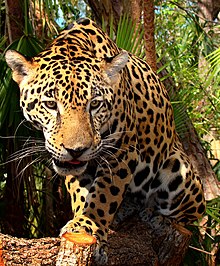
It wasn't until I plundered wikipedia for this picture that I discovered that the Arizona jaguar is actually a separate species P. onca. arizonensis..


http://en.wikipedia.org/wiki/Jaguar

Monday, March 15, 2010

ENDANGERED: Jaguar habitat appeal

This appeal for help in assisting the survival of jaguars in the US was sent to Richard Freeman at the weekend, but you'll see the deadline is today - so time is of the essence, if you want to do your bit.


Center for Biological Diversity
*Please take action by Monday, March 15*


After a decade-long fight for the survival of jaguars in the United States, the Center for Biological Diversity won a court ruling last year to protect North America's largest native big cat. Now, in response to the Center's extensive litigation, the Fish and Wildlife Service has announced it will designate critical habitat for the jaguar. This is excellent news for the endangered big cat -- but the question of where the jaguar's critical habitat will be located remains unanswered.

The Center is proposing the Sky Islands and Gila headwaters/Mogollon Rim regions of Arizona and New Mexico be designated as jaguar critical habitat vital to the recovery of the species. Parts of southeastern New Mexico, West Texas, and Southern California should also be included in the designation.

Please submit comments in support of the Center's proposal to designate critical habitat for the endangered jaguar by Monday, March 15. Your email, with personal touches added to reflect specific places you want to highlight, will help convince the U.S. Fish and Wildlife Service to take a "can-do" attitude toward conserving the lands necessary for jaguar recovery in the United States.


Click here to find out more and take action.


If you have trouble following the link, go to http://action.biologicaldiversity.org/p/dia/action/public/?action_KEY=2568.


Sample letter:

Subject: Jaguar Critical Habitat

Please designate critical habitat for jaguars throughout the entirety of the Sky Islands and the Gila/Mogollon Rim regions of Arizona and New Mexico.

I also support critical habitat for jaguars in portions of other regions such as southeastern New Mexico, West Texas, and Southern California.

The Sky Islands ecosystem consists of isolated mountain ranges that have long been inhabited by jaguars. As recently as last March, jaguar "Macho B" was known to live and roam in the Pajarito, Atascosa, Tumacacori, and Baboquivari Mountains. Other jaguars have been confirmed in the Chiricahua, Peloncillo, and Animas Mountains. These and other sky islands, along with the desert lands between them, have been identified by the Jaguar Conservation Team as potential jaguar habitat, providing habitat for jaguar prey such as deer and javelina.

Please also designate the Gila National Forest in New Mexico and the Mogollon Rim in Arizona, along with adjoining lands, as critical habitat. These uplands with vast coniferous forests supporting deer, elk, and javelina were home to the last known female jaguar and possible jaguar reproduction up till the 1960s. The Gila and Mogollon Rim were also identified as potential jaguar habitat by the Jaguar Conservation Team.

Other undeveloped areas in southeastern New Mexico, West Texas, and Southern California should also be designated as critical habitat for jaguars.

Thank you for your consideration.

Friday, September 25, 2009

SAVE AMERICAN JAGUARS

I think that I made my opinions clear on the burgeoning use of online petitions by pressure groups the other day. However, when an online petition that directly mentions an animal of interest to the cryptozoological community comes along, it would be plain wrong of me to ignore it. Especially as some months ago we carried stories on this very issue.

American Jaguars Need Your Help to Survive
Target: U.S. Interior Secretary Ken Salazar
Sponsored by: Center for Biological Diversity

In May, the last known U.S. jaguar -- Macho B -- was unnecessarily, tragically killed by government agencies. This heartbreaking loss to the species, and to us, demands swift action to preserve habitat for the majestic cats.

If jaguars are to rebound, as wolves and grizzlies have, they need a federal recovery plan, reintroduction from Mexico to the United States, and protection of their essential living space.

The Center for Biological Diversity, a nonprofit conservation group, recently won a court case requiring the Fish and Wildlife Service to develop a recovery plan and designate critical habitat for jaguars. But instead of complying with the law, the agency is delaying by appealing the ruling.

Jaguars don’t have time to wait. Sign the petition urging the Service to comply with the Endangered Species Act requirements to save and recover the American jaguar.

http://www.thepetitionsite.com/takeaction/976724429


Monday, February 23, 2009

Jaguar Japes and Jollity

So, what exactly is the status of Jaguars in northern Mexico and the southern United States? In the past few weeks there have been a couple of news stories about this beautiful beast.

First of all The National Geographic website carried this story:
February 11, 2009—The largest cat in the Americas is alive and well in the heart of Mexico, scientists say. Three photographs of a male jaguar and exactly 132 poop samples (including the one above, released February 10) are the first known evidence of the predator since the early 1900s. The big cat was snapped by a camera trap in the Sierra Nanchititla Natural Reserve.

I really wish that scientists wouldn't use the word 'poop'. I understand that the words `shit` and `crap` have become swearwords in some echelons of society, but there are still perfectly socially-acceptable synonyms for the process and product of defecation, such as `droppings`, `dung`, or `scat`. However this is just a pet niggle of mine and I digress. Back to the jaguars:

Sierra Nanchititla Natural Reserve is in the south of Estado Mexico, (the State of Mexico), a Mexican state in the central south of the country. Confused? So am I. I will now refer you to Wikipedia, an institution which, though flawed, has its uses.

The State of Mexico is (as the name implies) a state in the middle of Mexico but, again according to Wikipedia , slap bang in the middle of known Jaguar territory. However, the park's website whilst being understandably proud of the presence of jaguars despite the original story (see above) having been splashed all over the world's press.

Now ths story gets more complicated.Take a look at THIS picture. Yup, its another jaguar. And, yup, it is wearing a collar somewhat reminiscnet of that worn by a racing greyhound here in the UK. Does that mean that the CFZ have discovered an illegal jaguar racing cartel? No, of course not.

I will refer you to an article in the L A Times last week which reads:

"A jaguar was captured southwest of Tucson this week during an Arizona Game and Fish Department research study. The study was actually aimed at monitoring black bear and mountain lion habitats.The male cat has been fitted with a satellite tracking collar and released. The collar will provide biologists with location updates every few hours and it is hopeful that this data will provide information on a little-studied population segment of this species. This is the first time in the U.S. that a jaguar has been able to be followed in this manner."

Well, bloody hell that's good news isn't it? You cannae argue with a live jaguar Captain! However, other newspapers and internet commentators have implied that ths evcidence is unique. Well, it is and it isn't. This picture was taken, also outside Tucson, back in 2004, and was accompanied in the original article in the Arizona Daily Star with these quotes:

"This is the most jaguars that have been seen at one time, in one area, since the early 20th century," said Michael Robinson of the Center for Biological Diversity. "It's certain that at least one jaguar has been able to make a living in Southern Arizona since 2001", said Bill Van Pelt, head of the Game and Fish Department's non-game mammals program. "But a true population would have yielded more photos, and there still is no evidence of female jaguars north of the border", he said.

"When I hear the word 'population,' that implies a breeding population where they're self-sustaining," Van Pelt said. "Until we've documented there are females, we just have dispersing individuals."

Right on Mr Van Pelt (although that is an unfortunate name when one is dealing with the conservation of an animal which has been hunted widely for its coat). But nothing seems to have changed in the last five years. Despite claims in the cryptozoological community that expeditions should be sent out to prove that jaguars were not hunted to extinction in Arizona 110 years ago, there is no evidence that anything untoward has happened. Jaguars are known to live in Central Mexico in the Sierra Nevada which is less than 200 miles south of Arizona. Young male jaguars are regularly wandering from there into the southern United States. Hopefully the Mexico-United States Barrier will not do too much to stop this happening in the future.

What will be really cool will be when a female jaguar crosses the border, and then we can all get excited at the prospect of jaguars returning to the United States as breeding natives for the first time since 1900.