http://news.mongabay.com/2011/1114-ucsc-west_coelacanth.html


Half a century ago, Belgian Zoologist Bernard Heuvelmans first codified cryptozoology in his book On the Track of Unknown Animals.
The Centre for Fortean Zoology (CFZ) are still on the track, and have been since 1992. But as if chasing unknown animals wasn't enough, we are involved in education, conservation, and good old-fashioned natural history! We already have three journals, the largest cryptozoological publishing house in the world, CFZtv, and the largest cryptozoological conference in the English-speaking world, but in January 2009 someone suggested that we started a daily online magazine! The CFZ bloggo is a collaborative effort by a coalition of members, friends, and supporters of the CFZ, and covers all the subjects with which we deal, with a smattering of music, high strangeness and surreal humour to make up the mix.
 Unlike some of our competitors we are not going to try and blackmail you into donating by saying that we won't continue if you don't. That would just be vulgar, but our lives, and those of the animals which we look after, would be a damn sight easier if we receive more donations to our fighting fund. Donate via Paypal today...
 http://austriantimes.at/news/Around_the_World/2009-08%2027/15970/Prehistoric_monster_terrorises_kids_in_the_Ganges
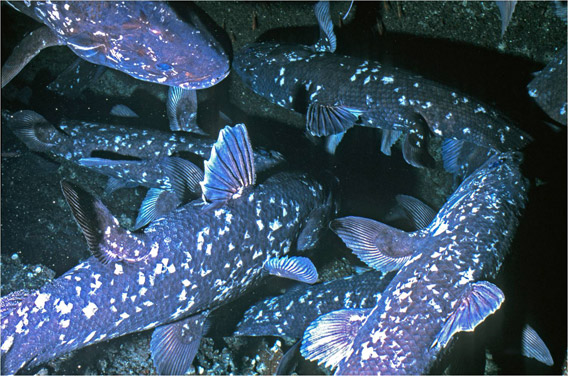
Kudos must go to Loren Coleman for his correct diagnosis. The creature in these photographs is NOT a Coelacanth. It is a grouper but of what species, I am uncertain. The dead fish differs from a Coelacanth in the following ways:
1. Coelacanths have very obviously 2 completely separate dorsal fins. The dead fish does not have this feature.
2. Coelacanths have “Bony fins”, such that the true fin appears to come out of a little leggy stump. The dead fish has no suggestion of this at all, and its fins are typical of normal ray finned fish.
3. This fish is a Perciform fish. This large group of ray finned fish has a spiny dorsal fin, which is a very good diagnostic characteristic. The dead fish has this feature, Coelacanths don’t.
4. The caudal (tail) fin is so completely different in both fish that it is not worth much consideration.
5. Coelacanths are typified by having large scales. The dead fish clearly has very fine scales.
I could go on, but I won’t. If I knew much about groupers (I don’t) I would try and identify it to species. However, because of the large size of the fish I would say it has to be from either Mycteroperca or Epinephelus. More than that, I could not say with certainty but I would back Loren’s postulation that it is an orange spot, Epinephelus coioides.
Unfortunately, this intriguing headline is backed up by absolutely nothing; a shame.



 Posts
Posts


