WELCOME TO THE CFZ BLOG NETWORK: COME AND JOIN THE FUN

Half a century ago, Belgian Zoologist Bernard Heuvelmans first codified cryptozoology in his book On the Track of Unknown Animals.

The Centre for Fortean Zoology (CFZ) are still on the track, and have been since 1992. But as if chasing unknown animals wasn't enough, we are involved in education, conservation, and good old-fashioned natural history! We already have three journals, the largest cryptozoological publishing house in the world, CFZtv, and the largest cryptozoological conference in the English-speaking world, but in January 2009 someone suggested that we started a daily online magazine! The CFZ bloggo is a collaborative effort by a coalition of members, friends, and supporters of the CFZ, and covers all the subjects with which we deal, with a smattering of music, high strangeness and surreal humour to make up the mix.

It is edited by CFZ Director Jon Downes, and subbed by the lovely Lizzy Bitakara'mire (formerly Clancy), scourge of improper syntax. The daily newsblog is edited by Corinna Downes, head administratrix of the CFZ, and the indexing is done by Lee Canty and Kathy Imbriani. There is regular news from the CFZ Mystery Cat study group, and regular fortean bird news from 'The Watcher of the Skies'. Regular bloggers include Dr Karl Shuker, Dale Drinnon, Richard Muirhead and Richard Freeman.The CFZ bloggo is updated daily, and there's nothing quite like it anywhere else. Come and join us...

Search This Blog

WATCH OUR WEEKLY WEBtv SHOW

SUPPORT OTT ON PATREON

SUPPORT OTT ON PATREON
Click on this logo to find out more about helping CFZtv and getting some smashing rewards...

SIGN UP FOR OUR MONTHLY NEWSLETTER


Unlike some of our competitors we are not going to try and blackmail you into donating by saying that we won't continue if you don't. That would just be vulgar, but our lives, and those of the animals which we look after, would be a damn sight easier if we receive more donations to our fighting fund. Donate via Paypal today...


Showing posts with label BOOK REVIEW. Show all posts

Tuesday, November 18, 2014

BUY JIM JACKSON'S NEW BOOK AT A SPECIAL LOW PRICE

In this new anthology of short stories West Country author Jim Jackson takes a lead in the restoration of this once popular genre and in so doing escorts us upon a wide-ranging flight of the imagination. From Orpington and Africa to Australia and Georgia. From inner to outer space. Lovers, millionaires, scientists and fugitives from justice are just some of the characters he paints for us with colourful precision. Every narrative is a miniature masterpiece in a great storytelling tradition and an ideal diet for those who prefer to savour their literature in well-crafted bitesized portions.

It is available for pre-order on Amazon at:


1: 
United States9.99 USD

2: 
United Kingdom7.49 GBP

3: 
Canada10.99 CAD

4: 
Australia10.99 AUD


But because we are all certifiably mad here, for a limited time only, you can buy this charming book at a special low price:


1: 
United States7.99 USD

2: 
United Kingdom5.49 GBP

3: 
Canada8.99 CAD

4: 
Australia8.99 AUD


UNITED KINGDOM
UNITED STATES AND CANADA


AUSTRALIA

Wednesday, January 22, 2014

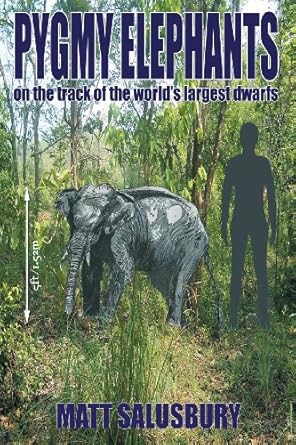
MATT SALUSBURY: Pygmy Elephants


I am very proud of the books that we produce through the CFZ Publishing Group. But I am particularly proud of this latest volume: Matt Salusbury's peerless book about Pygmy Elephants.

He writes:

If ever there was a contender for 'giant dwarfs' or 'the world's biggest dwarf', pygmy elephants are it. Even a five-foot at the shoulder pygmy elephant would still be a massive beast. I wanted to call this work Slightly Smaller Elephants - Possibly but I was persuaded that Pygmy Elephants had a better ring to it.

There have in the past - millions to hundreds of thousands of years ago - been smaller species of elephants, well-documented in the fossil record, some of whom we will meet shortly. And there have been claims made for the existence of living pygmy elephants in various remote and not-so-remote parts of the world today.


  • It is already getting good reviews on Amazon. For example, Adam C writes:
This is THE natural mystery tour! If you enjoy thrillers or natural history, then this is for you. If you enjoy both, then you're getting even greater value.

Put natural history, mystery and a tour of some of the world's most remote habitats together and this is the result. Yes, it is greater than the sum of the parts and no, it's never dry.

Matt Salusbury may not (yet) have the television reputation of the great Sir David Attenborough, but this particular zoo quest (American readers: ask your great grandparents in the UK to explain the reference) is a joy. His mixture of personal and academic styles, his journalistic quizzing of researchers more accustomed to facing the jungles of Africa than the jungle of the media brings delightful elucidation and sheds a refreshing (if not entirely complimentary) light on laboratory life and scientific ecology in the 21st century.

What could, in other hands, have been a dry text condemned to sit alongside bones on laboratory shelves, gathering dust but little interest, has been transformed into what at one point reminded me of a school nature trail for seven-year-olds, but on a truly continental scale.

Expect the unexpected. This is a howdunnit, a wheredunnit and an ecological who-hid-it. As for the ending? That's a natural mystery too - until the reader gets there. But the style and substance mean that such progress might not take as long as you had thought (but sleep or other tasks may be delayed).

It's a giant tale about a small creature. Taking the skin of this pachyderm and dissecting what's inside may be too crude a metaphor for some, but the result is an exploration of innards that would have fascinated a Roman soothsayer and intrigued this 21st-century vegetarian.

Hit click - and start this track for yourself now. It's a journey well worth following.

  • Paperback: 334 pages
  • Publisher: CFZ Press (10 Dec 2013)
  • Language: English
  • ISBN-10: 1909488151
  • ISBN-13: 978-1909488151
  • Product Dimensions: 1.8 x 15.4 x 23 cm

Now in a special offer for bloggyfolk, you can buy it from us at a special price of £10.00 - a discount of £2.50.

Thursday, October 03, 2013

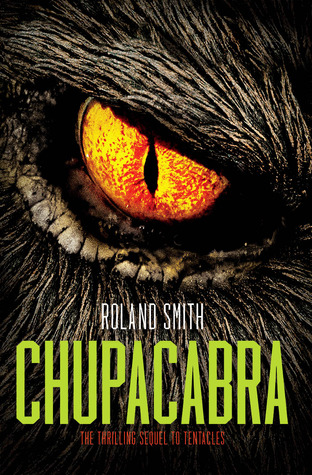
CHUPACABRA by Roland Smith

Chupacabra (Marty and Grace #3)

  • Hardcover: 336 pages
  • Publisher: Scholastic Press (24 Sep 2013)
  • Language: English
  • ISBN-10: 0545178177
  • ISBN-13: 978-0545178174


Some years ago I reviewed a rather spiffing book called Tentacles . A friend of mine, a young lady called Elizabeth Clem who lives in Indiana, first introduced me to the work of Roland Smith when she sent Corinna and me his book Cryptid Hunters as a wedding present. I enjoyed it massively. The author's website describes it:


After their parents are lost in an accident, thirteen-year old twins Grace and Marty are whisked away to live with their Uncle Wolfe - an uncle that they didn't even know they had! The intimidating Uncle Wolfe is an anthropologist who has dedicated his life to finding cryptids, mysterious creatures believed to be long extinct.

As I wrote at the time, this is a woefully inadequate description and is 'a bit like describing Anna Karenina as being about a couple of Russian chicks and some horse racing.' But now I am happy to say that the third volume of the saga is out and I have to say I think that I enjoyed it even more than I did the first two, and that is saying something!

I particularly enjoy these stories even though Roland himself told me, "I actually thought about you when I was developing Wolfe and Marty... There is a bit of you in both of them". There is a famous quote by Groucho Marx that he would not join any club that had him in it, and I probably wouldn't either. But I am happy to say that Roland's three books, which have a teensy weensy bit of me in their DNA, are absolutely smashing.

NOW HOLD ON A MOMENT: I am hoping this review will make anyone who has not already read these books go out and buy them, so I am giving away as few plot details as I can. However, I have to reveal a few things, so although this is not a full-blown SPOILER ALERT, there are, I am afraid, a few.

In this book, Wolfe is conveniently off dealing with the Government and so the main protagonists of the story are the two children introduced in Vol 1, their friend Luther (introduced in Vol 2) and a third young person, conveniently old enough to drive but still young enough not to be part of the adult world.

At the end of Volume Two, Grace - who had only recently discovered that Wolfe was her father - had voluntarily gone off with the satisfyingly villainous villain Dr Noah Blackwood (who also happens to be her maternal grandfather), and spends much of the book trying to escape from Blackwood's high-tech headquarters. The three boys, meanwhile, spend the book trying to break in and rescue her.

It is Grace who develops as a character most in this book. She very satisfyingly sheds some of her girlishness  and becomes much more tough and resourceful. However - and this is the big bit of congratulations due to the author for his literary skill - Smith makes this transformation happen naturally, just as part of Grace's growing process. I have rarely seen the transformation of a character so deftly handled.

Adults can, I think, read more into the character descriptions of Blackwood and the other major villains than can (one hopes) the audience for whom this book is largely intended. He is truly evil, and what's more, the sort of evil who can justify every one of his misdeeds. Blackwood and several of his henchfolk make even adult readers wince, so I can only imagine the delightful frisson of horror that will be felt by juvenile minds reading these stories for the first time.

The bad news is that after this, all the indications are that there will only be one story left to complete the saga. Let's hope that Roland will be merciful on us, and continue the series longer. I now know what various neices and nephews of mine are going to have for Christmas from their favourite uncle.

Wednesday, August 07, 2013

Lee Brickley's Terrifying New Book


UFO's Werewolves & The Pig-Man
(Exposing England's Strangest Location – Cannock Chase)

"UFOs, werewolves, orbs, more monsters than an old Universal Studio film. Cannock Chase has them all, and now Lee Brickley is bringing them all into your living room in his exciting new book."
                                   Brad Steiger


The eternally mysterious woodlands of Cannock Chase in Staffordshire, England, are known throughout the world as an entry point for bizarre and unearthly paranormal phenomena. From werewolf sightings and spectral encounters, to documented UFO crashes and spooky urban legends, this supernatural portal area experiences more inexplicable activity than you even dare imagine.

In this book Lee Brickley chronicles his investigation into the very location many researchers call “England's Strangest”. With brand new sighting reports, spine-tingling tales of gruesome monsters, and fresh information on the alleged top secret military connection that could be responsible for it all, are you brave enough to find out what's really going down in the woods today?

About the Author:
Lee Brickley is a British freelance writer and publisher who works for several magazines and websites. Lee
has a particular interest in paranormal/cryptozoological themes and has been writing on the subject for many
years. With appearences on many top radio shows, big things are on the horizon for this dedicated new
author. You can contact him directly at leebrickleyauthor@gmail.com

Or for more info on the mysteries and happenings on Cannock Chase, his paranormal blog can be found at:
www.paranormalcannock.blogspot.co.uk

Quotes:
"Cannock Chase has long been known as a UFO hotspot and a place where all sorts of other paranormal
phenomena have occurred. It's one of the UK's most mysterious locations and might even get into a global
Top 10 list of spooky sites, alongside such places as Area 51, Roswell, the Bermuda Triangle and a few
others."  Nick Pope, MoD UFO Project, 1991-1994

“At first glance, Cannock Chase is a wonder to behold with its amazing and abundant natural beauty.
However, there is another part of Cannock Chase that dwells within the shadows. A place where madness
has substance and nightmares have their own perverse allure. Cannock Chase is as mysterious as it is
beautiful. It is a place where the veil is thin, allowing brief glimpses between this world and the next”
Paranormal author Tim Swartz

"A high plateau bordered by the Trent Valley to the north and the West Midlands to the south, the huge and
picturesque Cannock Chase has been an integral feature of the Staffordshire landscape for generations.
There is something deeply weird about the Chase: it has strange and monstrous inhabitants in its midst.
Werewolves, large black cats, aliens, spooks and spirits, Bigfoot, wallabies, wild boar, and huge snakes
have all been reported from within the depths of these mysterious woods..." Nick Redfern, author of
many books including Monster Diary and Wildman

"Cannock Chase has been the centre of many unusual sightings over the years. The Cannock Chase Beast' is
probably the most legendary phenomena, but other supernatural horrors have been reported as well.
Unknown hominids and serpents reportedly haunt the infamous forest, creating caution for those who
travel through it” Fortean author Lon Strickler

"Cannock Chase is like a slice of the ancient medieval forests that covered England. Somehow this world
within a world has survived in the heart of modern industrial Britain. Should we really be surprised that
some of its 'residents' are so strange?"  Cryptozoologist Richard Freeman

“Lee presents a fascinating and detailed insight into Cannock Chase and the mysteries that surround this
region. His understanding of the area and strong local knowledge offer any reader and fan of the
unexplained the chance discover why this area plays an important role within the UK's rich history of the
unknown” Colin Hall, author of Fact or Fiction? The Paris & M6 Crashes

Check it out...

Monday, May 28, 2012

RICHARD F GOES TO BOGGY CREEK

THE BEAST OF BOGGY CREEK: Lyle Blackburn, Anomalist Books, 2012
ISBN: 1933665572

Almost anyone with an interest in cryptozoology will have seen Charles B. Pierce’s classic low buget 1972 horror flick The Legend of Boggy Creek, the atmospheric docu-drama-style with the shadowy ape-thing haunting the bayoux and river bottoms, and periodically emerging to terrify small rural communities such as Fouke and Jacksonville. The story was based on real events and the film utilized real witnesses. The movie was more than the sum of its angles. A man in an ape suit wandering around in the shadows was transformed into something genuinely disturbing. The film had an immediacy to it. It felt like it could happen in your own back yard. No amount of CGI or big name Hollywood actors could ever recapture its feel, as proved by the worthless 2011 remake.

The Fouke Monster, as it became known, has been covered in other books on hominids both in the USA and worldwide. But Lyle Blackburn’s work, The Beast of Boggy Creek, focuses in on this one area, and is all the better for it. The Beast of Boggy Creek is also unique in that it looks not only at the sightings of the creature / creatures, but at their cultural and social effects.

There is a detailed history of Fouke, a small town in southwest Arkansas close to the border with Texas, and a comprehensive list of creature sightings stretching back to 1909 and up to 2010. The scene is thus set for the events of 1971 when a spate of sightings and an attack made the newspapers, and grabbed the attention of the world.

Lyle skilfully recounts the strange saga, interviewing people who lived through the events. He also chronicles the story of how the cult film, based on the encounters, was made on a wing and a prayer, and went on to become a classic of Fortean cinema.

The film spawned a whole sub-genre of low budget sasquatch films, none of which captured the brooding menace of the first movie.

When the dust settled and the world’s attention moved on, the sightings continued. Lyle records many such encounters through the ‘70s, ‘80s and ‘90s, to the present day, with some of the later sightings arguably even more dramatic than the ‘classic’ period. Many of these have never been recorded prior to this book and it is always good to read new information.

Of special interest to both movie buffs and cryptozoologists is a scene by scene breakdown of Pierce’s classic, comparing each scene with the real life events that inspired it.

Theories as to the nature of the beast are examined, including the old chestnut of an escaped ape from a circus train wreck, a Scooby-Doo-style scare story to keep people away from moonshine stills, or even a horror invented to keep black people away from the town! The author tentatively comes down on the side of an unknown species of ape and I must agree with him here.

The monster’s appearances in books, records, TV and memorabilia is also looked at.

You could have all the information above and still have a lousy book if it were not presented well, but Lyle shows himself not only to be a first-rate researcher but a master of the written word. The Beast of Boggy is almost poetic in its delivery, making it not only a mine of information but a pleasure to read as well.

In the words of the narrator of The Legend of Boggy Creek “I was seven years old when I first heard him scream. It scared me then and it scares me now.”

10 /10

Saturday, January 07, 2012

WHAT AN UNBELIEVABLY GOOD BOOK

Paperback: 160 pages
Publisher: Markosia Enterprises Ltd (1 Oct 2011)
ISBN-10: 1905692609
ISBN-13: 978-1905692606
Product Dimensions: 24 x 16.2 x 0.8 cm

I would probably have been predisposed to have given this book a positive review because it comes complete with endorsements from Nick Redfern and Neil Arnold, but now it has a glowing endorsement from me as well: it is a cracker!

The first in (I hope) a long series, this tells the story of a young Welsh boy thrown by tragedy into a maelstrom of historic horror. It has more than its fare share of stuff for the crypto-enthusiast, including dragons and a massive mystery cat, but what is most impressive as far as I am concerned is the way that the day to day nightmare of being an adolescent schoolboy is interplayed with the ancient battle of wills being played out around the young protagonist of the novel. In this way it occupies much the same ground as Richard Freeman's book of short stories, which is out any day now.

This is a masterful book, and I for one cannot wait for the sequel(s). JD

Sunday, November 20, 2011

WREDFERN WRITES...

Just published by Britain’s CFZ Press is a brand new book from Richard Freeman, of the Center for Fortean Zoology, one of the very few full time groups in the world dedicated to uncovering the truth behind Bigfoot, the Yeti, sea-serpents, the Chupacabra, and much more of a beastly nature.

Over the course of the last few years, Richard has been on a number of expeditions to the island of Sumatra in search of its very own equivalent of Sasquatch: It has become known as the Orang-Pendek.

Read on...

Monday, September 26, 2011

REDDERS REVIEWS GLEN - with impressive results

Several years ago the British-based Centre for Fortean Zoology – one of the very few groups in the world dedicated to investigating strange creatures on a full-time basis – embarked upon an ambitious project. The idea was to publish a series of books on unusual and unknown animals reported throughout the length and breadth of Britain, on a county-by-county basis. And given that the nation has a lot of counties that means a lot of books!

Fortunately, the CFZ has proved to be fully up for the challenge and the group has now published a number of titles under the banner of The Mystery Animals of the British Isles, including books that cover the counties of Kent, the Western Isles, Northumberland and Tyneside. And I’m pleased to announce the CFZ has just released the latest in this on-going series. Written by Glen Vaudrey, it covers the Northern Isles, which can be found north of mainland Scotland.

Read on...

Thursday, August 11, 2011

BOOK REVIEW: `Killers on the Moor` - seriously flawed

I am about half way through reading Killers on the Moor by Mike Freebury.

It is very well produced, and Freebury is an engaging, likeable and witty writer, and his tale of investigating animal mutilations at home and abroad is well written and enjoyable.

However, and this is such a big however that it needs to be printed:

HOWEVER

There are some unforgiveable mistakes. Alarm bells began ringing in my mind as soon as I started reading his account of the Newquay Zoo animal mutilations of 1977, and more specifically the involvement of the late Mrs Joan Amos in investigating them.

I knew Joan quite well, and I am certain that she told me that she had not investigated the matter for herself, but had only received the documents and information third hand via a contact in the Plymouth UFO Group.

I published a lengthy account of the case in The Owlman and Others (first published 1997), in which I put at least one of the outstanding queries to bed. The lumps on the jaws of the wallabies were due to an infection by Fusobacterium necrophorous, a condition known colloquially as 'lumpy jaw.' It is a well-known condition in captive marsupials and not at all mysterious or sinister. If you want to know more about the condition click this link:

http://www.marsupialsociety.org/jaw_disease2.html

I cannot prove that Freebury is wrong about Joan's involvement in the case because she has been dead for years and it is my memory versus his word! However, when he comes on to the next case, the Loftus wallaby slashing, I can and will provide a list of refutations:

1. The case did not take place in 2003. It was August 2002; the 21-23rd to be exact (my 43rd birthday).
2. I have never been in charge of an organisation called the Crypto Zoologist Foundation. Presumably he means the Centre for Fortean Zoology (CFZ)
3. I did not send Richard to Loftus. The two of us travelled up there together.
4. The team from Scream Team were not in the area by chance. I arranged to liaise with them, and they paid Richard's and my expenses.

...and so on.

I would like to think that these mistakes are just one-off aberrations. The book is otherwise very interesting and makes some good points. However, in a later chapter the descriptions of the events surrounding Joan's time in hospital during 1978 are at variance with my memory of what she told me, and there are large chunks of her research into animal mutilations and missing domestic cats that have been ignored, so I am inclined to think that other parts of the book may be equally as flawed.

So this is strange. I like the book, and I agree with many of his conclusions, but what the bloody hell was he thinking when he was researching it?

Monday, March 21, 2011

RICHARD FREEMAN BOOK REVIEW

Monsters of Pennsylvania
Patty A Wilson
Stackpole Books 2010 ISBN-13: 978-8117-3625-1

One of the advantages of having a multi-volume, multi-author series, is the differing styles in which they are written. Coleman and Hallenbeck write in a calm, almost detached, manner somewhat like field biologists recording data. Patty Wilson is much more like a traditional storyteller, recounting sightings like an author writing passages from a novel.

The monsters of the Keystone State are dominated by sasquatch with over half the book taken up by encounters with mystery primates. Wilson has cherry-picked the most dramatic and re-tells them with a flare that would make Stephen King proud.

Some of these encounters are standard (if one can ever use such a term when encountering a Bigfoot) sightings of what appears to be a yeti-like upright ape. Others have an element of ‘high strangeness’ including a man’s roadside encounter with an ape-like beast that seemed capable of teleportation.

Known Bigfoot but still humanoid creatures are reported within the state. One case sticks out in particular. The Ridge Road monster, reported in the late '60s, was described by witnesses as an emaciated giant with a skull-like face, glowing eyes and grey skin. The description sounds somewhat like the Algonquin India cannibal spirit the Wendigo. I am currently researching a book on the creature and have other sightings on record that sound much the same, some from as far south as Kentucky.

Known humanoid monsters in the book include eastern cougars, out-of-place panthers, giant snakes and the ever popular thunderbird. Also our old friend the Jersey Devil who seems just as changeable here as it does in New Jersey.

For a state with so many German immigrants in its history, it is no surprise that the werewolf raises its head in Pennsylvania. Some of the stories here are from colonial times but much harder to explain are modern-day sightings of bipedal, hairy creatures with wolf-like heads. Some of the most recent occurred around the campus of West Chester University. A student prank or something stranger?

Thus far Stackpole have given us two impressive titles. Let’s hope that the remaining states get treatment as impressive as these.

Sunday, February 27, 2011

RICHARD FREEMAN: `Monsters of New Jersey` Review

Monsters of New Jersey
Loren Coleman and Bruce G Hallenbeck
Stackpole Books 2010 ISNB-13:978-08117-3596-4

A couple of years back the CFZ decided to launch a series of books highlighting the mystery animals of the UK and Ireland with books tackling individual counties. Now Stackpole Books are embarking on a similar series for US states. The first in the series looks at strange beasts reported in the state of New Jersey. Loren Coleman should be familiar to any fortean worth their salt, having been in the field for decades and having penned such classics of the genre as Mysterious America and Curious Encounters. Co-author Bruce G Hallenbeck is a screen writer and film director.

In the book’s introduction the authors state how New Jersey’s monsters are hard to pigeon-hole and they are quite right. The states weird critters seem to defy and attempt to categorize them beyond the most basic and by their nature seem nebulous and fluid.

Case in point is the state’s most famous monster the Jersey Devil, variously described as resembling a bird, a deer, a horse, a dragon, a hairy biped and all kinds of ungodly hybrids of the afore-mentioned. Only the most basic outline of a winged, two-legged creature emerges when the descriptions are examined. The Jersey Devil, like the chupacabra, is likely to be a catch-all term for odd creatures seen in the Pine Barrens. The weird stories about its genesis have likely grown up around the phenomenon rather than visa versa.

Other creatures examined include Bigfoot, with ‘wildman’ reports going back as far as 1759. Stranger by far is the ‘Monkey-Man’ scare of 1982 were the students of all the schools in the Hoboken were convinced in the existence of a simian beast that lurked in school hallways, threw children out of windows and had killed a teacher. Needles to say the fiend almost certainly had no existence outside of the minds of frightened kids but it was a weird precursor to the much later Monkey-Man scares in Delhi, India.

An interesting sideline is given in the chapter dealing with freshwater monsters: the all too real case of a shark that swam 11 miles inland up Matawan Creek in 1911 and killed a number of people. The case supposedly inspired the book and film Jaws.

The best part of the book, though, is the chronological list of all known Jersey Devil sightings. It is the most comprehensive and up to date list available and really does showcase how variable and odd the state demon’s manifestations are.

Monsters of New Jersey is an interesting first volume in what promises to be a highly collectable series.

Saturday, February 26, 2011

OLL LEWIS REVIEWS 'FELIDAE'

Film Review: Felidae

When most people think of cartoons they tend to think of the mild and sanitised output of Western animation studios where cartoons are aimed squarely at a family audience and anything sad, violent and unjust that occurs to a good or nice person is neatly resolved and corrected by the end of the movie. True, it is not strictly necessary to the plot of many animations to include scenes that deal with the harsh realities of life, and may be a little jarring when juxtaposed with Jamaican crabs extolling the virtues of life beneath the ocean through the medium of song, but it is the animated films that go the extra mile to include a window, however small, into the dark side of life that stick in your mind. Examples of this include the death of Bambi's mother, which turned a rather twee and otherwise forgettable film into a children's classic, Fievel getting separated from his parents in An American Tale; and the death of Carl's wife in Up, which will have even the most composed person close to tears despite it being a cartoon and only about 10 minutes into the film.

Some films go further, though; typically European animation studios will make films that don't just include a window into darkness but can sometimes break open a whole wall. One animated movie that does this is Felidae, a German film based on the novel of the same name by Akif Pirinçci it is essentially a film noir where the main characters are house cats. Like most film noir and hard-boiled detective fiction it pulls few punches and soon descends into dark and murky territory as its protagonist, Francis, a sort of feline Philip Marlowe, investigates a series of gruesome cat murders. With scenes of decapitation, disembowelment, animal experimentation, cat 'love-making' and corpses turned into puppets and made to dance by Gregor Mendel (don't ask) this is perhaps not the sort of film you should show your children but really don't let that put you off, the film is tastefully done and its plot will have you gripped from start to finish.

The film possesses several layers dealing with the complex social interactions between the different cats, and indeed their owners, and the capacity for cruelty and evil present in both cats and humans, eugenics and the misuse of religion as well as the search for the serial killer that forms the main plot of the movie. In the social interactions between the various cats the fact that they are cats and not humans is never lost sight of, whereas some anthropomorphism has been employed to enable the viewer to relate to the characters and the story it is never taken to the level where the cats could easily be humans wearing furry suits. Over anthropomorphism is a plague that effects far too many Western cartoons and as a fan of all kinds of animation it really sets my teeth on edge like in Disney's 'Home on the Range' when a cow makes a joke about breast implants (for goodness sake she's a COW why would she know or care about plastic surgery!) and I was glad to see Felidae did not fall into that trap.

The film starts with Francis's owner, or 'can opener' as cat-slang would have it, moving to a dilapidated old house that used to be owned by a scientist. As soon as he arrives Francis sees the body of a cat in the garden with it's throat cut and meets a local tom cat called Blue Beard. Blue Beard is of the opinion that the murder, of which this is the fourth to occur recently is probably the work of humans but Francis is not as sure and together the pair start investigating the deaths (reluctantly so on Blue Beard's part). Soon another victim is found and Francis notes that both victims were male cats who had recently attempted to mate, suggesting a possible sexual motive for the killings. That night Francis witnesses a cat's religious cult meeting in the old laboratory of his new home and is chased off by them. When he finds safety he meets a blind cat named Felicity who he befriends. It turns out that Felicity witnessed, or at least heard several of the murders. Blue Beard then takes Francis to meet the most intelligent cat he knows, Pascal, a cat who has actually learnt how to operate a computer, in the hope that he will be able to shed some light on the case. While at Pascal's house it is learnt that Felicity has been murdered and Francis runs to her house where he sees her decapitated body. The fact that she was female and the frenzied nature of the attack suggests that Francis' initial thoughts on the motive of the killer may be wrong. Needless to say the plot thickens from this point on and to go into it much further would spoil the film. As Felidae is quite an obscure film in Britain and the USA (unjustly so, when other European animations which are pretty to look at but possess lesser plots, like 'Belleville Rendez-vous' are Oscar bait) chances are you were not even aware of its existence before you read this review and you will, I hope, want to see it for yourself I really don't want to ruin it by giving away all the little twists.

Felidae is a rare treat a Western animation for grown ups that is not preoccupied by showing off it's adult credentials by including unnecessary shocks and just lets it's dark plot unfold before your eyes. It's animation also is of a high quality as is it's English dub and voice-cast which puts the dubbing employed by several companies, that actually specialise is re-dubbing mostly Japanese cartoons, to shame. The only problem that the film has is that because of the animation's running time and the complexity of the source material things can seem a little rushed at times, but that will hardly stilt many peoples enjoyment of what is a marvellously executed and original animated film.

(8/10)

Tuesday, January 25, 2011

REDFERN REVIEWS

Nick Redfern reviews Stan Gordon's new book, Silent Invasion: The Pennsylvania UFO-Bigfoot Casebook.

http://forteanreviews.blogspot.com/2011/01/silent-invasion-bigfoot-ufos.html

Friday, January 21, 2011

NICK REDFERN REVIEWS `PARANORMAL AMERICA`

Countless books have been written - by believers and skeptics alike - on such paranormal topics as UFOs, Bigfoot, lake-monsters, ghosts, demons, the Bermuda Triangle, ESP, tarot-cards, and astrology. And on quite a bit more, too!The problem is that not only do the vast majority of those same books very often (albeit not necessarily deliberately) reflect the subconscious prejudices of their respective authors, but they tend to focus more so on the data, than they do on the witnesses to the respective phenomena and the personalities that investigate them.

Read on

Monday, January 17, 2011

HARRIET WADHAM: An extremely random book review of Animal Farm

At our school we have a study centre. It’s actually our librarybut it’s called the study centre because you can do more than just read.

I had the great fortune to come across a copy of Animal Farm. I’ve finished it now and am onto Mary Shelley’s Frankenstein, but that’s another book review to be written later on. Anyway, the book reminds you of man’s cruelty to beast and how sometimes we can underestimate other people; for instance, when Jones, the animals’ tyrannical owner, misjudges his animals’ capability of overthrowing him they kick him out onto the streets. This is mostly Jones’s fault for getting drunk, conking out and waking up to the sound of his animals gorging themselves on the food he forgot to give them.

After the now free animals kick him out, they resolve to bring in the best harvest the farm had ever seen, and they succeed, naturally.

They aspire to do all sorts of new things, the likes of which the farm has never seen - but alas! The plans are peed on by Napoleon, a child of the superior breed of pigs! However, none of the other animals know it was Napoleon. The reason I wrote, ‘superior breed of pigs’ is that the pigs fashion themselves as the leaders of the animals, due to their superior intelligence. At the head of all this is Snowball, the lead pig, who slaves away at those designs, only to have them urinated on by Napoleon. The pigs have previously taught themselves to read and write out of an old spelling book of Jones’s children, so as to make sure everything runs smoothly on the farm.

In a nutshell, George Orwell has spun a tale of deceit, lies, triumph and betrayal that really makes you think about the actions of the human race. I for one know that animals have feelings like humans do. But do you?

Probably.

Thursday, January 13, 2011

REDFERN REVIEWS YOKAI

Richard Freeman's new book, The Great Yokai Encyclopedia: An A to Z of Japanese Monsters, is an appropriately Godzilla-sized book (it runs to 416 pages!) and is a definitive look at the strange creatures and beasts of Japan, both in times past and the present day. A wealth of dedication, hard work and diligent study has gone into making this book a triumphant tour de force on one of the most sadly overlooked aspects of cryptozoology, monster-hunting and strange creatures.

Collectively known as the Yokai, the monsters of Japan are largely unknown in the West. But by addressing the cultural background that gave rise to these legends, and then listing the creatures in detailed encyclopaedic form, however, Richard Freeman has now firmly and decisively rectified that situation for one and all.

This is a truly magical title that demonstrates not only Freeman's love and appreciation of Japan's rich folklore, history and mythology of a monstrous nature, but that also reveals his profound knowledge of the subject, too - not to mention his patience in putting the mighty tome together in the first place! Freeman writes in an informative and entertaining style that ensures you'll keep turning the book's pages to learn what is coming next.

I recommend The Great Yokai Encyclopedia to anyone and everyone that wishes to learn more about the fantastic beasts, mythical monsters, unknown animals, and creepy critters of Japan. Winged monsters, dragons, man-beasts, water goblins and much more - they all feature within the packed pages of this book. Invest in a copy and you won't be disappointed!

Monday, December 27, 2010

MICHAEL NEWTON: True Giants—True Story?

We’ve all heard stories of Bigfoot, Sasquatch, Yeti, Yowie—pick your moniker of preference. By any name, it’s said to be a hulking, hairy biped of six to nine feet tall, leaving trails of humanoid footprints fourteen to sixteen inches long. But what if there was something even bigger lurking in the wilderness? Let’s say a creature resembling Bigfoot but towering twelve to twenty feet tall, with feet twenty to thirty inches long.

It would, to say the least, be startling.

In fact, for generations there have been reports of truly massive “Bigfeet” seen in North America and all around the world. Coupled with claims of Sasquatch popping in and out of UFOs, they have embarrassed authors who treat cryptozoology as a serious discipline, but simply ignoring the hairy Goliaths hasn’t made them go away. Neither has the incessant ridicule heaped upon seemingly sober witnesses by sceptics and professional debunkers.

Now, at last, veteran cryptozoologists Mark Hall and Loren Coleman have tackled the problem head on, in their new book True Giants: Is Gigantopithecus Still Alive? Their answer to that question is a qualified affirmative.

Hall coined the term 'true giants' back in 1992, thirty-odd years after Ivan Sanderson proposed the prehistoric ape Gigantopithecus as a Bigfoot-Yeti candidate—or “neo-giant”—within a list of four proposed unknown hominid species worldwide. Sanderson, however, chose to skirt the issue of bipedal monsters twice the normal size ascribed to Sasquatch. Myra Shackley followed Sanderson’s lead two decades later in her book Wildman: Yeti, Sasquatch and the Neanderthal Enigma (1983; American title, Still Living?), while paleoanthropologists Russell Ciochon, John Olsen and Jamie Janes considered Bigfoot tangentially in their 1990 work Other Origins: The Search for the Giant Ape in Human Prehistory. Grover Krantz endorsed an evolved and altered species of Gigantopithecus as Bigfoot in 1992, naming it G. canadensis.

While most students of cryptozoology recognise “Giganto” as a favourite Bigfoot/Yeti candidate, many may be unaware that German anatomist-anthropologist Franz Weidenreich (1873-1948) renamed the creature Giganthropus, treating it as a primitive ancestor of Homo sapiens. Weidenreich’s view did not prevail against Edward Cope’s rule that population lineages tend to increase in size over evolutionary time, but dissenters persist—including authors Hall and Coleman, along with Australian cryptozoologist Rex Gilroy.

Whether or not readers of True Giants finally agree with their premise, Hall and Coleman rate kudos for collecting all the available evidence on “true giants” and reviewing it even-handedly. The final product is a handsome volume, featuring cover art by Alika Lindbergh (former wife of Bernard Heuvelmans) and twenty-three black-and-white illustrations, with all material fully sourced. Overall, True Giants is a valuable addition to the literature of Sasquatchery and natural mysteries.

Tuesday, October 26, 2010

Nick R reviews `The Mystery Animals of Ireland`

Well, I'm pleased to say that there is now a brand new edition to the growing Mystery Animals of... series. This one covers Ireland and comes to us courtesy of cryptozoologist Gary Cunningham and surely the funniest (in every sense of the word!) man in Forteana, Ronan Coghlan, who my wife Dana refers to as a "lovable hoot"!

I read this book in two sittings, late at night and into the early hours, and while sprawled out on the settee, and I can say for certain that this is an absolutely excellent addition to this on-going series of titles.

What Gary and Coggers have done is to finally, definitively, and once and for all, offer the reader a comprehensive, in-depth, and very well-written study of the many and varied mystery animals of Ireland that cover centuries-past to the present day.

Read on

Friday, October 01, 2010

NEIL ARNOLD REVIEWS MIKE AND RUBY

AUSTRALIAN BIG CATS: AN UNNATURAL HISTORY OF PANTHERS
Written By Mike Williams & Rebecca Lang
Published by Strange Nation ISBN 978-0-646-53007-9

Only a handful of books have ever been written about what are known in the UK as ‘alien big cats.’ This is a term I’ve always despised. Some of the books written have been informative little booklets or like Marcus Matthew’s Big Cats Loose In Britain (CFZ Press 2007) they’ve existed as a superb guide to local legends and headlines through each county. Karl Shuker’s now hard to find Mystery Cats Of The World was also a pioneering book at the time but since then not enough books have emerged on the subject.

So, step forward Rebecca Lang and Mike Williams, who have decided to write a book on the mystery cats of their native Australia. I’m sure many people didn’t even realise that Australia has a similar situation to the UK with its legends of large, feline predators; mind you, there are many countries across the world that have been plagued by cat flaps, but these stories are yet to form a manuscript.


Of all the books I’ve read on the ‘big cat’ mystery, Australian Big Cats is without doubt the finest. Even the most hardened of sceptics will enjoy this truly monstrous - and I mean monstrous at over 400 pages - read. Packed with fascinating eye-witness reports and data, Rebecca and Mike have also littered their work with some impressive photographs not just of huge paw-prints, slaughtered livestock and old newspaper reports, but fascinating photographs of the secretive animals themselves. After reading this detailed tome, which is nigh on exhaustive regarding the Australian situation, you’ll be more informed of the media sensationalism which gave birth to legends such as the ‘Beast of Buderim’, the ‘Broken Hill Lioness’, the ‘Canterbury cat’, the ‘Kaiapoi Tiger’, and of course the ‘Emmaville Panther’ which has become a media darling to rival our very own ‘beasts’ of Exmoor, Bodmin and the like in Britain.


However, these Australian dwellers are not the stuff of foggy folklore, and exist in some reasonably impressive photographs, and of course that ever elusive film footage which seems, rather hilariously, to drive most big cat ‘researchers’ mad in their quest for their own Holy Grail. Rebecca and Mike look at the facts, and debate whether Thylacoleo carnifex - a large marsupial cat - could still exist thousands of years after its alleged extinction. They examine reports of large cats escaping into the Australian bush, some as rumour, some as fact, backed up with photographs. The book eliminates the suspects, sifts through the mounting evidence, and also proves, startlingly, that the scrublands and forests of Australia are also inhabited by truly gigantic feral cats, one of which had its head blown off by a hunter. These monster moggies are a mystery in a field of their own, but are clearly no match for the eye-witness reports which suggest that black leopard and puma hide in the woodlands.


Written without bias, Australian Big Cats despite its size (and weight!) is an engrossing read (I read it straight through in two days), and it comes highly recommended. As a full-time researcher myself, I take my hat off to Rebecca and Mike for giving us a unique glimpse into what lurks in the shadows Down Under.


With so many eye-witness reports and evidence piling up, I’m pretty sure their sequel may not have to include the word ‘unnatural’ in its title, because surely it’s only a matter of time before such animals are taken seriously. And it’s books such as this which go a long way to aiding us in our quest for the truth. Get your paws on a copy now.


Rating: 9/10
Available from Amazon.com
Neil Arnold October 2010